Muscles, explained · Lesson 12
Which exercises work the upper, middle and lower traps?
One move per part: shrugs with your arms about 30° out for the upper traps, shoulder blades squeezed at the end of your row for the middle, and Y raises lying on your stomach for the lower. These picks rest on measured activation: none of these studies compares which exercise grows the traps the most.
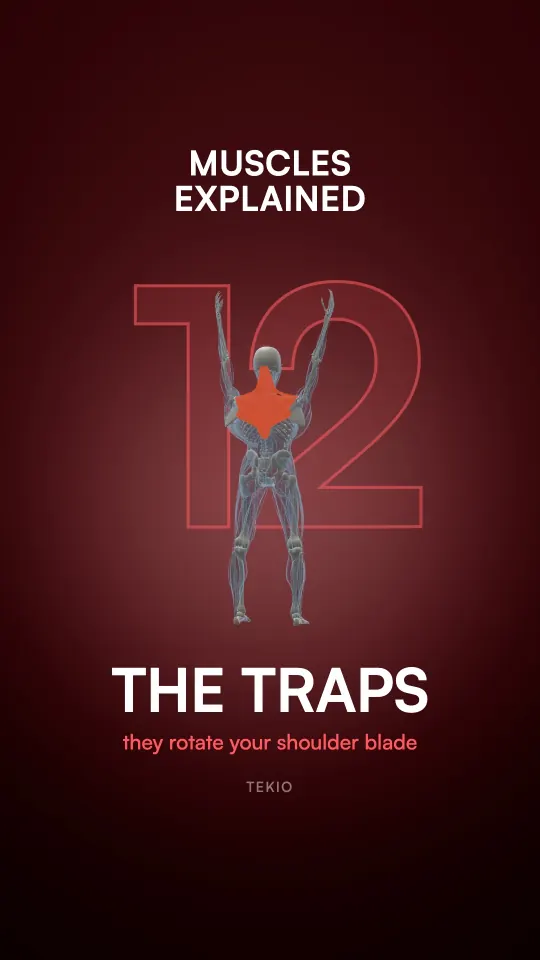
Where are your traps?
Your two traps form one big diamond, from the back of your skull down to the middle of your back. On the sides, they attach to your clavicle and your scapula, your shoulder blade. Each one has three parts: the upper, the middle and the lower.
In dissections, the fibers from the back of the skull and the neck run to the clavicle; those from the base of the neck, almost horizontal, to the acromion and the spine of the scapula; those from the back converge on the spine of the scapula. The thickest start at the base of the neck (Johnson et al., 1994).
What do the traps do?
When you shrug, the upper part lifts your scapula by swiveling your clavicle: that’s elevation. For the authors of the dissection study, its almost horizontal fibers mostly pull the scapula and clavicle back, or lift the scapula through that rotation of the clavicle, rather than hoisting it straight up (Johnson et al., 1994).
The middle part, with the rhomboids hidden underneath, squeezes your shoulder blades together: that’s retraction. In 12 adults, measured with fine-wire electrodes, the middle traps and rhomboids worked together in all four positions tested (Fennell et al., 2016).
When your arm goes up, the traps rotate your scapula upward (Ekstrom et al., 2003). Arm all the way up, it had rotated 36° on average, in 21 healthy adults (Yano et al., 2010). That’s why your traps work on lateral raises: in 20 young men, upper, middle and lower trap activity rose as the arm moved out and up, with a plateau (Bagg and Forrest, 1986).
Which exercises for the upper, middle and lower traps?
For the upper part, on shrugs, spread your arms about 30°: your scapula rotates as well as lifts. In 23 adults without pain and 14 with an unstable shoulder, the upper and lower traps activated more than with the arms at the sides (Pizzari et al., 2014).
For the middle, squeeze your shoulder blades at the end of your row: it works there with your rhomboids, which are even slightly more active (Fennell et al., 2016).
For the lower part, Y raises lying on your stomach: out of 10 exercises tested in 30 adults, that’s where it activated the most (Ekstrom et al., 2003). Arms below shoulder height, side-lying external rotation and wall slides activated it about a third less than the Y, in 32 adults (Garcia et al., 2023). In 45 adults, side-lying external rotation and forward arm raise, horizontal abduction with external rotation and extension lying face down worked the lower and middle traps with little upper-trap activity (Cools et al., 2007). Pull-ups work the lower traps too, more with an overhand grip than with chin-ups, in 25 adults (Youdas et al., 2010).
Which exercise grows your traps the most?
Your traps do grow with lifting: upper-trap fiber cross-section grew 36% in ten weeks in 9 women (Kadi and Thornell, 2000); the upper traps thickened over ten weeks in 21 trained men (Bartolomei et al., 2021); the lower traps, by 0.3 mm after six weeks of shoulder-blade exercises in 19 office workers with shoulder pain (Go and Lee, 2016).
But the exercise comparisons above all measure how the traps activate: none compares which exercise grows them the most. They show where the traps work, not where they grow the most.
Your workout plan, built for your body.
In Tekio, your plan targets your traps and you watch them progress on your body, week after week.

Sources
Studies checked in PubMed. Measured muscle activity isn’t growth: each fact keeps its study’s population and limits.
- Johnson G, Bogduk N, Nowitzke A, et al. (1994). Anatomy and actions of the trapezius muscle. Clin Biomech (Bristol) 9(1):44-50. PubMed · DOI
- Fennell J, Phadke CP, Mochizuki G, et al. (2016). Shoulder Retractor Strengthening Exercise to Minimize Rhomboid Muscle Activity and Subacromial Impingement. Physiother Can 68(1):24-8. PubMed · DOI
- Ekstrom RA, Donatelli RA, Soderberg GL (2003). Surface electromyographic analysis of exercises for the trapezius and serratus anterior muscles. J Orthop Sports Phys Ther 33(5):247-58. PubMed · DOI
- Yano Y, Hamada J, Tamai K, et al. (2010). Different scapular kinematics in healthy subjects during arm elevation and lowering: glenohumeral and scapulothoracic patterns. J Shoulder Elbow Surg 19(2):209-15. PubMed · DOI
- Bagg SD, Forrest WJ (1986). Electromyographic study of the scapular rotators during arm abduction in the scapular plane. Am J Phys Med 65(3):111-24. PubMed
- Pizzari T, Wickham J, Balster S, et al. (2014). Modifying a shrug exercise can facilitate the upward rotator muscles of the scapula. Clin Biomech (Bristol) 29(2):201-5. PubMed · DOI
- Garcia JF, Herrera C, Maciukiewicz JM, et al. (2023). Variation of muscle recruitment during exercises performed below horizontal arm elevation that target the lower trapezius: A repeated measures cross-sectional study on asymptomatic individuals. J Electromyogr Kinesiol 70:102777. PubMed · DOI
- Cools AM, Dewitte V, Lanszweert F, et al. (2007). Rehabilitation of scapular muscle balance: which exercises to prescribe? Am J Sports Med 35(10):1744-51. PubMed · DOI
- Youdas JW, Amundson CL, Cicero KS, et al. (2010). Surface electromyographic activation patterns and elbow joint motion during a pull-up, chin-up, or perfect-pullup™ rotational exercise. J Strength Cond Res 24(12):3404-14. PubMed · DOI
- Kadi F, Thornell LE (2000). Concomitant increases in myonuclear and satellite cell content in female trapezius muscle following strength training. Histochem Cell Biol 113(2):99-103. PubMed · DOI
- Bartolomei S, Nigro F, Malagoli Lanzoni I, et al. (2021). A Comparison Between Total Body and Split Routine Resistance Training Programs in Trained Men. J Strength Cond Res 35(6):1520-1526. PubMed · DOI
- Go SU, Lee BH (2016). Effects of scapular stability exercise on shoulder stability and rehabilitative ultrasound images in office workers. J Phys Ther Sci 28(11):2999-3002. PubMed · DOI
These lessons inform; they don’t replace advice from a health professional.