Muscles, explained · Lesson 13
Adductors: which exercises work your inner thighs?
The squat and the Copenhagen plank: ten weeks of full squats grew the adductors 6% in 8 men, because the adductor magnus also extends your hip. For adduction itself, eight weeks of Copenhagen training raised adduction strength by more than a third in young soccer players.
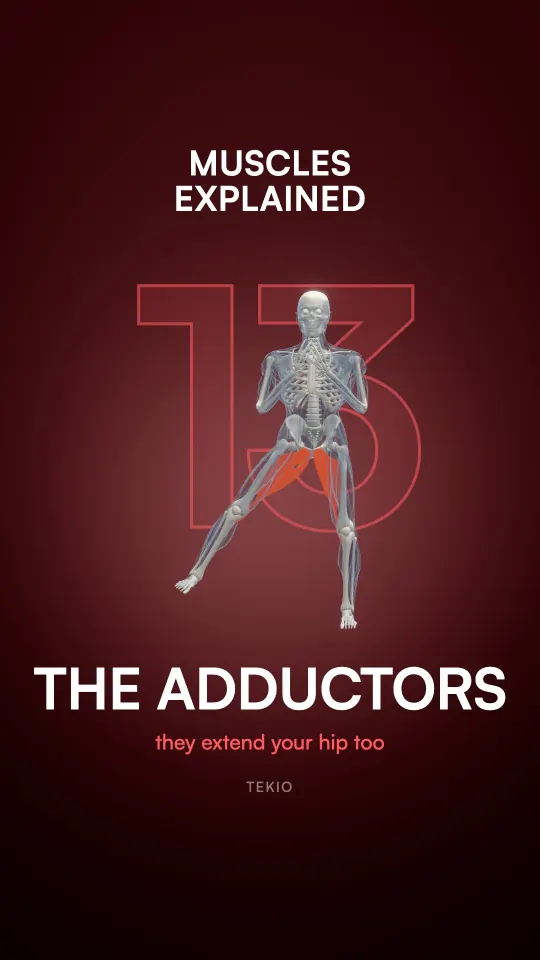
Which muscles make up your adductors?
On the inside of your thigh, five muscles make up your adductors: the adductor magnus, longus and brevis, the pectineus and the gracilis. They start at your pubis, at the bottom of your pelvis (Tharnmanularp et al., 2024), and run down along your femur; the gracilis goes all the way to the inner side of your shin bone (Lee et al., 2014).
The adductor magnus is one of the largest muscles in your leg (Takahashi et al., 2025). Its back part starts at your ischium, the bone you sit on (Hsu et al., 2026). In cadavers, it splits into several portions: the lower ones, with longer fibers, look built to move the thigh through a wide range, the top one to steady the hip (Takizawa et al., 2014).
What do the adductors do?
They pass on the inside of your hip: when they shorten, they pull your thigh toward the other one. That’s hip adduction.
But the back part of the adductor magnus passes behind your hip: it pulls your thigh backward. That’s hip extension, like your hamstrings. On MRI, in 15 young adults, its back and lower parts made up more than 80% of the muscle, with more leverage to extend the hip than to adduct it: its calculated force capacity was more than twice as high for extension (Takahashi et al., 2025).
Does the squat grow your adductors?
Yes: in a squat, as you stand up, your hip extends, and that’s the adductor magnus’s move. In 8 men, ten weeks of full squats grew their adductors by 6.2%, almost as much as their gluteus maximus (+6.7%); in 9 others, with half squats, by 2.7% (Kubo et al., 2019).
On the hip thrust, with equal sets, they grew less than on the squat, in 34 beginners, while the glutes grew just as much (Plotkin et al., 2023). The authors explain it, citing other work, by the adductor magnus providing the largest share of hip extension at the bottom of the squat: their study didn’t measure it.
Adduction machine or Copenhagen plank?
The adduction machine does train adduction, but we found no study measuring what it grows. For adduction itself, there’s the Copenhagen plank: lying on your side, your top leg, resting on a bench, lifts your body.
In two under-19 soccer teams (24 players), the team that added eight weeks of Copenhagen training to its usual practice gained 36% in eccentric adduction strength; the other team didn’t improve significantly (Ishøi et al., 2016). In 652 semi-professional soccer players, a program built on that single exercise made the risk of reporting groin problems 41% lower over the season (Harøy et al., 2019).
Your workout plan, built for your body.
In Tekio, your plan targets your adductors and you watch them progress on your body, week after week.

Sources
Studies checked in PubMed. Measured muscle activity isn’t growth: each fact keeps its study’s population and limits.
- Tharnmanularp S, Muro S, Nimura A, et al. (2024). Significant relationship between musculoaponeurotic attachment of the abdominal and thigh adductor muscles to the pubis: implications for the diagnosis of groin pain. Anat Sci Int 99(2):190-201. PubMed · DOI
- Lee JH, Kim KJ, Jeong YG, et al. (2014). Pes anserinus and anserine bursa: anatomical study. Anat Cell Biol 47(2):127-31. PubMed · DOI
- Takahashi K, Tozawa H, Kawama R, et al. (2025). Redefining muscular action: human "adductor" magnus is designed to act primarily for hip "extension" rather than adduction in living young individuals. J Appl Physiol (1985) 138(4):1088-1099. PubMed · DOI
- Hsu CY, Wu WT, Hsu YC, et al. (2026). Ultrasonographic Diagnosis of an Ischiocondylar Adductor Magnus Partial Tear: An Uncommon Cause of Ischial Pain. Diagnostics (Basel) 16(16):2583. PubMed · DOI
- Takizawa M, Suzuki D, Ito H, et al. (2014). Why adductor magnus muscle is large: the function based on muscle morphology in cadavers. Scand J Med Sci Sports 24(1):197-203. PubMed · DOI
- Kubo K, Ikebukuro T, Yata H (2019). Effects of squat training with different depths on lower limb muscle volumes. Eur J Appl Physiol 119(9):1933-1942. PubMed · DOI
- Plotkin DL, Rodas MA, Vigotsky AD, et al. (2023). Hip thrust and back squat training elicit similar gluteus muscle hypertrophy and transfer similarly to the deadlift. Front Physiol 14:1279170. PubMed · DOI
- Ishøi L, Sørensen CN, Kaae NM, et al. (2016). Large eccentric strength increase using the Copenhagen Adduction exercise in football: A randomized controlled trial. Scand J Med Sci Sports 26(11):1334-1342. PubMed · DOI
- Harøy J, Clarsen B, Wiger EG, et al. (2019). The Adductor Strengthening Programme prevents groin problems among male football players: a cluster-randomised controlled trial. Br J Sports Med 53(3):150-157. PubMed · DOI
These lessons inform; they don’t replace advice from a health professional.