Muscles, explained · Lesson 14
Lower back muscles: what do the erector spinae do?
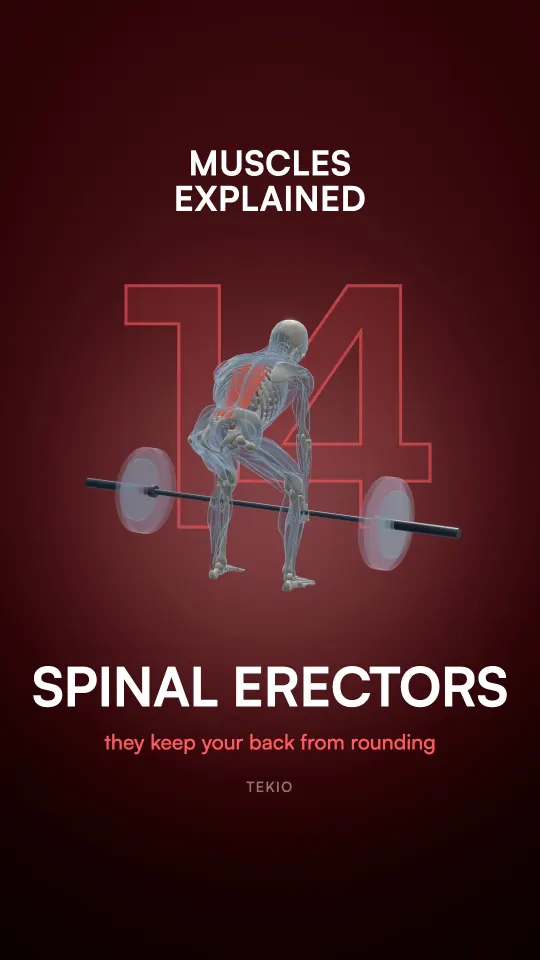
Your lower back muscles are your spinal erectors, the erector spinae: they straighten your spine, but in the gym their main job is to keep it from rounding while your hips do the movement. Heavy squats and deadlifts activate them far more than the superman; with your back rounded all the way, they switch off and your spine is held only by passive tissues, ligaments and stretched muscles. So on deadlifts, don’t let your back round all the way: let your erectors do the holding.
Which muscles are your lower back muscles?
What you call your “lower back” muscles are your spinal erectors: the erector spinae. On each side of your spine, they run from your pelvis up to your ribs.
In the lower back there are two of them, the iliocostalis and the longissimus. Their lumbar fibers start from the lumbar vertebrae and attach to the pelvis; their thoracic fibers start on the thorax and run down toward the pelvis through long tendons (Macintosh and Bogduk, 1987). Those thoracic fibers matter: in a model built on the X-rays of 9 standing volunteers, they provided half the force that straightens the last two lumbar vertebrae (Bogduk et al., 1992).
What do your lower back muscles do on the deadlift?
They run behind your vertebrae: when they shorten, they straighten your spine. That’s spinal extension.
But in the gym, their main job is to keep it from rounding. On the deadlift, the bar tends to round your trunk: the muscles that straighten your back and your hips keep it rigid (Shoji et al., 2025). Meanwhile, it’s your hip that bends and then straightens: hip extension does the movement.
Which exercise works the lower back the most?
In 16 people, squats and deadlifts at 80% of their max activated the spinal erectors far more than the superman, and more than the same lifts with body weight (Hamlyn et al., 2007). That’s measured muscle activity, not growth.
Rounded back on the deadlift: what holds your spine?
In 25 healthy adults bending forward as far as they could, the electrical activity of the erectors switched off in all of them before full flexion; in 20 people with chronic low back pain, that silence showed up in none (Shirado et al., 1995).
At the very bottom, passive tissues hold your spine. In a model built from 8 students bending all the way with 8 kg in their hands, the lower back erectors, electrically off, still pulled because they were stretched, like rubber bands, and the ligaments between the vertebrae were heavily loaded (McGill and Kippers, 1994).
Very good lifters stop short of that point: in 4 national-level powerlifters lifting 184 to 211 kg (about 405 to 465 lb), the lower back stayed 1.5 to 13° short of its full flexion (except in one lift); their ligaments weren’t stretched enough to carry the load, their muscles held it (Cholewicki and McGill, 1992).
The heavier the bar, the more the lower thoracic and upper lumbar spine round, in 13 young trained male athletes deadlifting at 60 to 90% of their max (Shoji et al., 2025). No consistent link has been shown between that rounding and injury, but it may put more stress on the discs between your vertebrae.
Does lifting heavier strengthen your lower back?
Not necessarily. On a lower-back machine, 41 adults who trained without the pelvis locked added 19 kg (42 lb) of load in 12 weeks without gaining strength measured with the pelvis locked; in the 21 who trained with the pelvis locked, that strength rose 23.5% compared with controls (Graves et al., 1994). Same finding on the 45-degree back extension bench (Mayer et al., 2003) and, in trained men, with Romanian deadlifts (Fisher et al., 2013): more weight lifted, no more strength measured with the pelvis locked.
But when the test was done on the same machine as the training, people who trained without the lock improved just as much (Mayer et al., 2002): the result depends on the test.
Your workout plan, built for your body.
In Tekio, your plan targets your lower back and you track its progress, week after week.

Sources
Studies checked in PubMed. Measured muscle activity isn’t growth: each fact keeps its study’s population and limits.
- Macintosh JE, Bogduk N (1987). 1987 Volvo award in basic science. The morphology of the lumbar erector spinae. Spine (Phila Pa 1976) 12(7):658-68. PubMed · DOI
- Bogduk N, Macintosh JE, Pearcy MJ (1992). A universal model of the lumbar back muscles in the upright position. Spine (Phila Pa 1976) 17(8):897-913. PubMed · DOI
- Shoji K, Nakayama K, Shiouchi M, et al. (2025). Load-dependent increase in lumbar kyphosis is associated with posterior pelvic tilt during deadlift. Front Sports Act Living 7:1682991. PubMed · DOI
- Hamlyn N, Behm DG, Young WB (2007). Trunk muscle activation during dynamic weight-training exercises and isometric instability activities. J Strength Cond Res 21(4):1108-12. PubMed · DOI
- Shirado O, Ito T, Kaneda K, et al. (1995). Flexion-relaxation phenomenon in the back muscles. A comparative study between healthy subjects and patients with chronic low back pain. Am J Phys Med Rehabil 74(2):139-44. PubMed
- McGill SM, Kippers V (1994). Transfer of loads between lumbar tissues during the flexion-relaxation phenomenon. Spine (Phila Pa 1976) 19(19):2190-6. PubMed · DOI
- Cholewicki J, McGill SM (1992). Lumbar posterior ligament involvement during extremely heavy lifts estimated from fluoroscopic measurements. J Biomech 25(1):17-28. PubMed · DOI
- Graves JE, Webb DC, Pollock ML, et al. (1994). Pelvic stabilization during resistance training: its effect on the development of lumbar extension strength. Arch Phys Med Rehabil 75(2):210-5. PubMed
- Mayer JM, Udermann BE, Graves JE, et al. (2003). Effect of Roman chair exercise training on the development of lumbar extension strength. J Strength Cond Res 17(2):356-61. PubMed · DOI
- Fisher J, Bruce-Low S, Smith D (2013). A randomized trial to consider the effect of Romanian deadlift exercise on the development of lumbar extension strength. Phys Ther Sport 14(3):139-45. PubMed · DOI
- Mayer JM, Graves JE, Udermann BE, et al. (2002). Development of lumbar extension strength: Effect of pelvic stabilization during resistance training. J Back Musculoskelet Rehabil 16(1):25-31. PubMed · DOI
These lessons inform; they don’t replace advice from a health professional.