Muscles, explained · Lesson 15
Obliques: what do they do and how do you train them?
Your obliques turn your torso along a diagonal, from one side to the other: to turn right, your left external oblique and your right internal oblique pull together. They also keep you still: in a side plank, they’re what stops your hips from dropping. To train them, turn your torso against a load, like a cable woodchop, then hold a side plank on your feet.
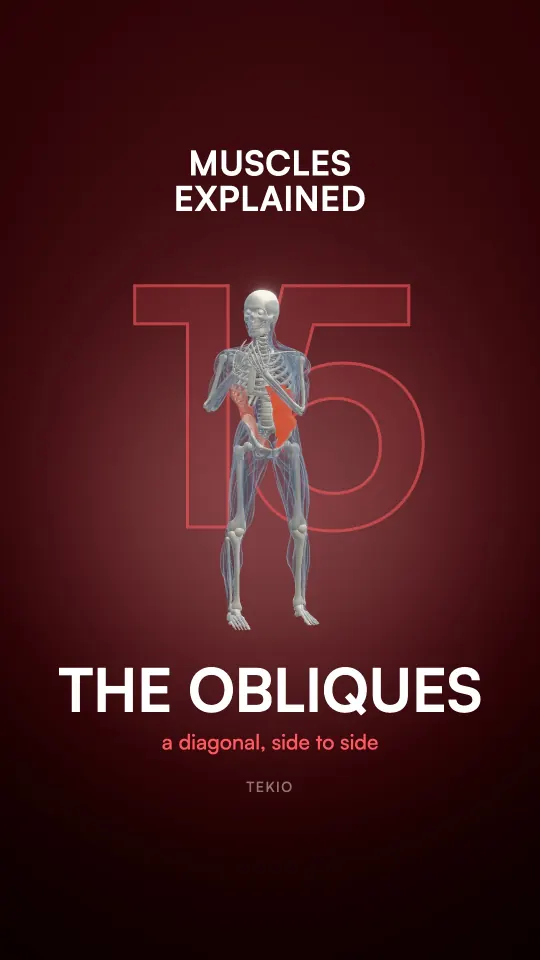
External and internal obliques: where are they?
Your obliques come in two layers on your sides: the external oblique on top, the internal oblique underneath. The external’s fibers run down from your lower ribs to the front of your belly.
Underneath, the internal’s fibers run the other way: in the upper and middle parts of the muscle, they run up toward the front; at the very bottom, they run back down (Urquhart et al., 2005, 26 dissected bodies).
Which oblique works when you turn your torso?
The left external oblique, as it shortens, pulls your left ribs forward: your torso turns to the right. The internal oblique, with its fibers the other way, has the opposite role: the right internal oblique also turns your torso to the right. So to turn right, your left external oblique and your right internal oblique pull together; end to end, they form a diagonal, from your left ribs down to your right hip.
In 50 young adults seated on a rotation machine, that pair started and held the rotation, along with the lat on the side you turn toward; the spinal erectors on that side seemed to hold the spine (Kumar et al., 2003). In 24 young men, the same muscles on the opposite side worked as antagonists, against the rotation (Fan et al., 2014).
Do your obliques work in a side plank?
Yes: your obliques also keep you still. In a side plank, your hips want to drop, and they’re what holds them up. In 18 adults aged 23 to 45, the external oblique worked harder in a side plank on the feet than in a crunch, a bent-knee sit-up or a plank on the knees (Escamilla et al., 2016).
Which exercises train your obliques?
Turn your torso against a load, like a cable woodchop, then hold a side plank. It’s not the side you turn toward that works: it’s a diagonal, from one side to the other.
Heavy squats don’t work them any harder: in squats and deadlifts at 80% of max, the external oblique worked no harder than with body weight, in 16 people; it was the spinal erectors that went up (Hamlyn et al., 2007). These measures show which muscle activates, not which one grows.
Your workout plan, built for your body.
In Tekio, your plan targets your obliques and you watch them progress on your body, week after week.

Sources
Studies checked in PubMed. Measured muscle activity isn’t growth: each fact keeps its study’s population and limits.
- Urquhart DM, Barker PJ, Hodges PW, et al. (2005). Regional morphology of the transversus abdominis and obliquus internus and externus abdominis muscles. Clin Biomech (Bristol) 20(3):233-41. PubMed · DOI
- Kumar S, Narayan Y, Garand D (2003). An electromyographic study of isokinetic axial rotation in young adults. Spine J 3(1):46-54. PubMed · DOI
- Fan JZ, Liu X, Ni GX (2014). Angular velocity affects trunk muscle strength and EMG activation during isokinetic axial rotation. Biomed Res Int 2014:623191. PubMed · DOI
- Escamilla RF, Lewis C, Pecson A, et al. (2016). Muscle Activation Among Supine, Prone, and Side Position Exercises With and Without a Swiss Ball. Sports Health 8(4):372-9. PubMed · DOI
- Hamlyn N, Behm DG, Young WB (2007). Trunk muscle activation during dynamic weight-training exercises and isometric instability activities. J Strength Cond Res 21(4):1108-12. PubMed · DOI
These lessons inform; they don’t replace advice from a health professional.