Deep muscles · Lesson 1
Transverse abdominis: what does it do and how to activate it?
The transverse abdominis is the deepest belt of your abs: as it tightens, it squeezes your belly, the pressure rises and stiffens your lower back, and it contracts before your arm even moves. On its own, it isn’t enough: in a simulation built from 8 men, bracing all your abs together made the spine 32% more stable than sucking in. So on the plank, don’t suck in your belly: brace all around.
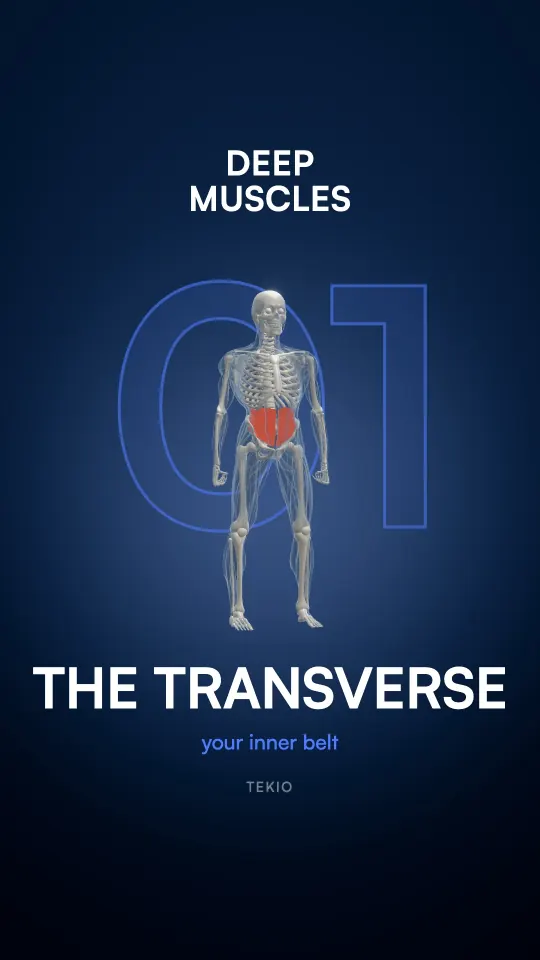
Where is the transverse abdominis?
It’s the deepest of your abs, hidden under your obliques. Its fibers wrap around your belly to your lower back, where it attaches to the lumbar spine through a fascia: horizontal at the top, they slant more and more downward lower down (Urquhart et al., 2005, 26 dissected bodies). A belt.
It’s also the thinnest: in 156 adults aged 18 to 44, thickness at rest went up from the transverse to the external oblique, the internal oblique and then the rectus abdominis (Tahan et al., 2016).
What does the transverse abdominis do?
When this belt tightens, it squeezes your belly, and the pressure inside rises. In 6 men, it was the ab muscle whose activity tracked that pressure most consistently (Cresswell et al., 1992). While you move an arm, it stays active along with your diaphragm, and belly pressure stays high (Hodges and Gandevia, 2000).
A pressurized belly stiffens your lower back, like a sealed bottle you can’t crush: in 3 volunteers lying down, raising that pressure without the abs or back muscles working made the lumbar spine stiffer (Hodges et al., 2005).
Why does the transverse contract before you move?
In 15 standing adults raising an arm as fast as they could, forward, to the side or backward, the transverse contracted before the deltoid, the shoulder muscle, whatever the direction; the other abs started earlier or later depending on the direction (Hodges and Richardson, 1997). The authors see it as a role in holding the trunk, as if to get it ready: that’s their hypothesis.
Should you suck in your belly to brace?
Not for stability. In a simulation built from 8 men (muscle activity and spine motion recorded, stability calculated in an ideal case), the transverse provided only 0.14% of the stability of a full brace. Bracing all around, all your abs together, made stability 32% higher than sucking in, with 15% more compression on the lower back (Grenier and McGill, 2007).
How do you feel your transverse abdominis?
Breathe out all the way. In 22 young adults, deep exhalation was when the transverse contracted most, more than in a crunch, especially with hips and knees bent at 90° (Hu et al., 2024, measured by ultrasound). These measures show when it works, not whether it grows.
Your workout plan, built for your body.
In your Tekio session, on the plank, don’t suck in your belly: brace all around.

Sources
Studies checked in PubMed. Measured muscle activity isn’t growth: each fact keeps its study’s population and limits.
- Hodges PW, Richardson CA (1997). Feedforward contraction of transversus abdominis is not influenced by the direction of arm movement. Exp Brain Res 114(2):362-70. PubMed · DOI
- Urquhart DM, Barker PJ, Hodges PW, et al. (2005). Regional morphology of the transversus abdominis and obliquus internus and externus abdominis muscles. Clin Biomech (Bristol) 20(3):233-41. PubMed · DOI
- Tahan N, Khademi-Kalantari K, Mohseni-Bandpei MA, et al. (2016). Measurement of superficial and deep abdominal muscle thickness: an ultrasonography study. J Physiol Anthropol 35(1):17. PubMed · DOI
- Cresswell AG, Grundström H, Thorstensson A (1992). Observations on intra-abdominal pressure and patterns of abdominal intra-muscular activity in man. Acta Physiol Scand 144(4):409-18. PubMed · DOI
- Hodges PW, Gandevia SC (2000). Changes in intra-abdominal pressure during postural and respiratory activation of the human diaphragm. J Appl Physiol (1985) 89(3):967-76. PubMed · DOI
- Hodges PW, Eriksson AE, Shirley D, et al. (2005). Intra-abdominal pressure increases stiffness of the lumbar spine. J Biomech 38(9):1873-80. PubMed · DOI
- Grenier SG, McGill SM (2007). Quantification of lumbar stability by using 2 different abdominal activation strategies. Arch Phys Med Rehabil 88(1):54-62. PubMed · DOI
- Hu N, Huang F, Yu R, et al. (2024). The investigation of ultrasound to assess lateral abdominal wall activation with different types of core exercises. BMC Sports Sci Med Rehabil 16(1):222. PubMed · DOI
These lessons inform; they don’t replace advice from a health professional.