Deep muscles · Lesson 2
Diaphragm: hold your breath or breathe out when lifting heavy?
It depends on the exercise: back supported on a machine, breathe out; heavy bar on your back or in your hands, take a breath and hold it. Holding didn’t change the strength measured, but it’s what puts your belly under the most pressure, and that pressure stiffens your lower back. In return, your blood pressure goes much higher: on the leg press, 311 mmHg holding versus 198 breathing out, for the same load, when normal is below 120.
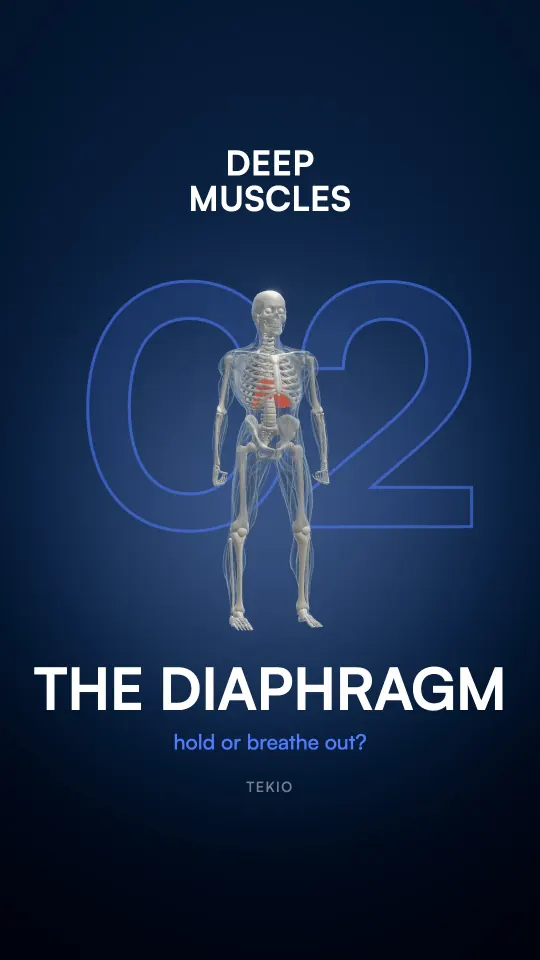
What does the diaphragm do?
It’s the dome under your lungs, the main muscle for breathing in. When you breathe in, it contracts, its dome moves down and pushes on your belly: the pressure inside rises (De Troyer and Boriek, 2011). Together with your abs, it keeps that pressure up while you move (Hodges and Gandevia, 2000).
That pressure stiffens your lower back. Researchers showed it by stimulating the diaphragm’s nerve with a current in 3 volunteers lying down, with neither their abs nor their back muscles working: their lumbar spine became 8 to 31% stiffer (Hodges et al., 2005).
Does holding your breath make you stronger?
Not according to the measurements: 13 men and 20 women pulled as hard as they could, knees bent and without moving, holding their breath or breathing out during the effort; their strength to straighten the back was the same (Hagins et al., 2006). The effort was static, against a fixed resistance.
But it’s what puts your belly under the most pressure: in 11 adults lifting a load, a deep breath held gave the highest belly pressure, more than normal breathing, holding with empty lungs or breathing out (Hagins et al., 2004). On the deadlift as on other lifts, that pressure even rises before the weight moves (Harman et al., 1988).
Does holding your breath raise your blood pressure?
Yes, sharply. In 10 male athletes on the leg press at their maximum load, blood pressure measured with a catheter in the artery averaged 311/284 mmHg when holding their breath, versus 198/175 mmHg when breathing out slowly during the push, for the same load lifted (Narloch and Brandstater, 1995). Normal blood pressure is below 120/80 mmHg (Whelton et al., 2018).
A review of 16 studies recommends exercises where these pressures stay lower, such as the bench press, for beginners and people with high blood pressure, and advises untrained people to adapt progressively before heavy squats or deadlifts (Blazek et al., 2019). If you have high blood pressure, ask your doctor.
So when should you hold, and when should you breathe out?
Back supported on a machine, like the leg press: breathe out. Heavy bar on your back or in your hands, on the squat or the deadlift: take your breath before you pull, and keep it on the way up. Holding your breath isn’t for lifting heavier: it’s for keeping your back solid.
This advice combines the studies above: none of them compares holding and breathing out on the squat for both blood pressure and back stiffness.
Your workout plan, built for your body.
In your Tekio session, on the deadlift, take your breath before you pull, and keep it on the way up.

Sources
Studies checked in PubMed. Measured muscle activity isn’t growth: each fact keeps its study’s population and limits.
- Narloch JA, Brandstater ME (1995). Influence of breathing technique on arterial blood pressure during heavy weight lifting. Arch Phys Med Rehabil 76(5):457-62. PubMed · DOI
- Hagins M, Pietrek M, Sheikhzadeh A, et al. (2006). The effects of breath control on maximum force and IAP during a maximum isometric lifting task. Clin Biomech (Bristol) 21(8):775-80. PubMed · DOI
- Hagins M, Pietrek M, Sheikhzadeh A, et al. (2004). The effects of breath control on intra-abdominal pressure during lifting tasks. Spine (Phila Pa 1976) 29(4):464-9. PubMed · DOI
- Hodges PW, Eriksson AE, Shirley D, et al. (2005). Intra-abdominal pressure increases stiffness of the lumbar spine. J Biomech 38(9):1873-80. PubMed · DOI
- De Troyer A, Boriek AM (2011). Mechanics of the respiratory muscles. Compr Physiol 1(3):1273-300. PubMed · DOI
- Hodges PW, Gandevia SC (2000). Changes in intra-abdominal pressure during postural and respiratory activation of the human diaphragm. J Appl Physiol (1985) 89(3):967-76. PubMed · DOI
- Harman EA, Frykman PN, Clagett ER, et al. (1988). Intra-abdominal and intra-thoracic pressures during lifting and jumping. Med Sci Sports Exerc 20(2):195-201. PubMed · DOI
- Whelton PK, Carey RM, Aronow WS, et al. (2018). 2017 ACC/AHA/AAPA/ABC/ACPM/AGS/APhA/ASH/ASPC/NMA/PCNA Guideline for the Prevention, Detection, Evaluation, and Management of High Blood Pressure in Adults: A Report of the American College of Cardiology/American Heart Association Task Force on Clinical Practice Guidelines. Hypertension 71(6):e13-e115. PubMed · DOI
- Blazek D, Stastny P, Maszczyk A, et al. (2019). Systematic review of intra-abdominal and intrathoracic pressures initiated by the Valsalva manoeuvre during high-intensity resistance exercises. Biol Sport 36(4):373-386. PubMed · DOI
These lessons inform; they don’t replace advice from a health professional.