Deep muscles · Lesson 3
Pelvic floor and squats: should you squeeze it during your set?
No need to squeeze it on every rep: your pelvic floor already contracts on its own when you brace, and in 11 women squatting, squeezing it on purpose didn’t make it hold back significantly harder. An hour of heavy squats and deadlifts didn’t tire it either, in 47 trained women. If you leak during effort, train it separately instead, outside your sets.
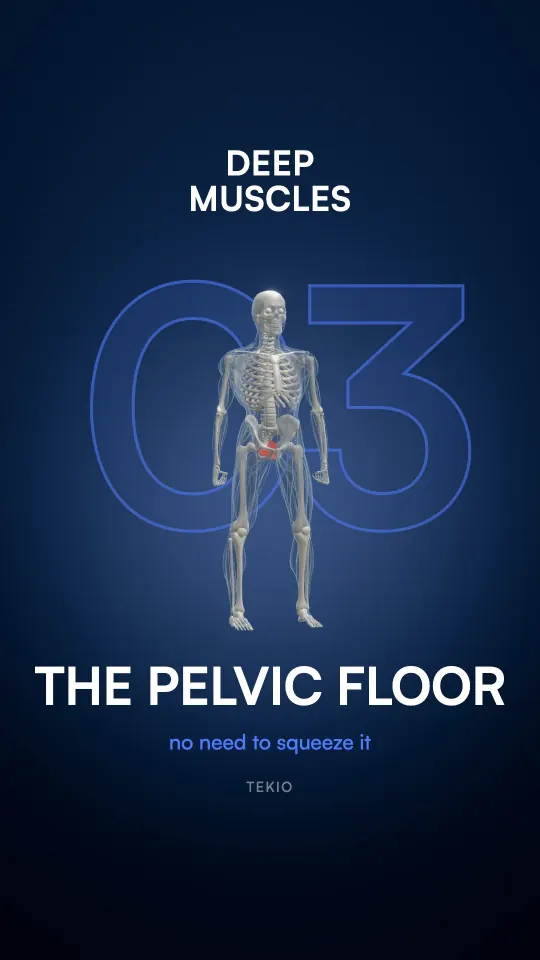
What is the pelvic floor?
Your pelvic floor is the group of muscles that closes the bottom of your pelvis. In men as in women, it holds up the bottom of your belly; in men, it’s made of several layers of muscle (Hodges et al., 2020).
When you brace, belly pressure pushes down on it, and it contracts on its own to hold it back (Bjurulf et al., 2026). It works with your abs: in 7 women, contracting the pelvic floor made the abs work; in a pilot test in 2 women, contracting the abs made the pelvic floor work (Sapsford et al., 2001).
Should you squeeze your pelvic floor during squats?
Researchers measured, with an intravaginal sensor, the pressure pushing down and the pelvic floor holding back in 11 women aged 18 to 35 who could lift their body weight on the squat, deadlift and leg press. On the squat, squeezing it on purpose didn’t make it hold back significantly harder than without thinking about it. On the deadlift, leg press and crunch, squeezing raised its pressure, but in none of the four exercises did it significantly exceed belly pressure (Bjurulf et al., 2026).
So the authors don’t recommend squeezing it to beat the pressure. These women had never trained their pelvic floor: the authors think it would need to be trained separately for that to work, which is still to be tested.
Does a heavy session tire your pelvic floor?
Not right afterward, in a trial of 47 trained women aged 18 to 35 who had never given birth: an hour of squats and deadlifts at 75 to 85% of their max changed neither the strength, the endurance nor the resting pressure of their pelvic floor, compared with an hour sitting down. And their squat or deadlift strength said nothing about their pelvic floor strength (Skaug et al., Med Sci Sports Exerc, 2024). The trial measured the effect of one session, not of years of training.
Leaking urine when lifting: what can you do?
It’s common: in a survey of 180 women and 204 men who had competed in a national powerlifting or weightlifting championship in Norway, 50% of the women and 9.3% of the men had urinary leaks, and 43% of the women didn’t know why to train their pelvic floor (Skaug et al., 2022). A survey like this doesn’t prove that lifting is the cause.
If you leak during effort, train your pelvic floor separately, outside your sets. In a randomized trial in 47 women doing functional fitness who leaked during effort, after 16 weeks of home exercises (3 sets of 8 to 12 maximal pelvic floor contractions a day), 64% reported feeling better, versus 8% without exercises. Their pelvic floor strength didn’t improve more than the others’, and none reported being cured (Skaug et al., Br J Sports Med, 2024). A specialized physio can teach you how.
The pelvic floor measurements and the exercise trial cited here only included women.
Your workout plan, built for your body.
In your Tekio session, on the squat, brace all around: your pelvic floor already follows.

Sources
Studies checked in PubMed. Measured muscle activity isn’t growth: each fact keeps its study’s population and limits.
- Skaug KL, Engh ME, Frawley H, et al. (2022). Prevalence of Pelvic Floor Dysfunction, Bother, and Risk Factors and Knowledge of the Pelvic Floor Muscles in Norwegian Male and Female Powerlifters and Olympic Weightlifters. J Strength Cond Res 36(10):2800-2807. PubMed · DOI
- Bjurulf C, Meng L, Budgett D, et al. (2026). Can Pre-Contraction of the Pelvic Floor Muscles Exceed Increases in Intra-Abdominal Pressure During Strength Exercises? Int Urogynecol J 37(6):1709-1720. PubMed · DOI
- Skaug KL, Engh ME, Bø K (2024). Acute Effect of Heavy Weightlifting on the Pelvic Floor Muscles in Strength-Trained Women: An Experimental Crossover Study. Med Sci Sports Exerc 56(1):37-43. PubMed · DOI
- Skaug KL, Engh ME, Bø K (2024). Pelvic floor muscle training in female functional fitness exercisers: an assessor-blinded randomised controlled trial. Br J Sports Med 58(9):486-493. PubMed · DOI
- Sapsford RR, Hodges PW, Richardson CA, et al. (2001). Co-activation of the abdominal and pelvic floor muscles during voluntary exercises. Neurourol Urodyn 20(1):31-42. PubMed · DOI
- Hodges PW, Stafford RE, Hall L, et al. (2020). Reconsideration of pelvic floor muscle training to prevent and treat incontinence after radical prostatectomy. Urol Oncol 38(5):354-371. PubMed · DOI
These lessons inform; they don’t replace advice from a health professional.