Muscles, explained · Lesson 11
Standing or seated calf raises: which grows your calves?
Standing calf raises, legs straight: in 14 beginners, over twelve weeks, the gastrocs grew 9 to 12% on the leg trained standing, versus less than 2% on the leg trained seated. With the knee bent, the gastrocs go slack; the soleus, which doesn’t cross the knee, grew the same both ways.
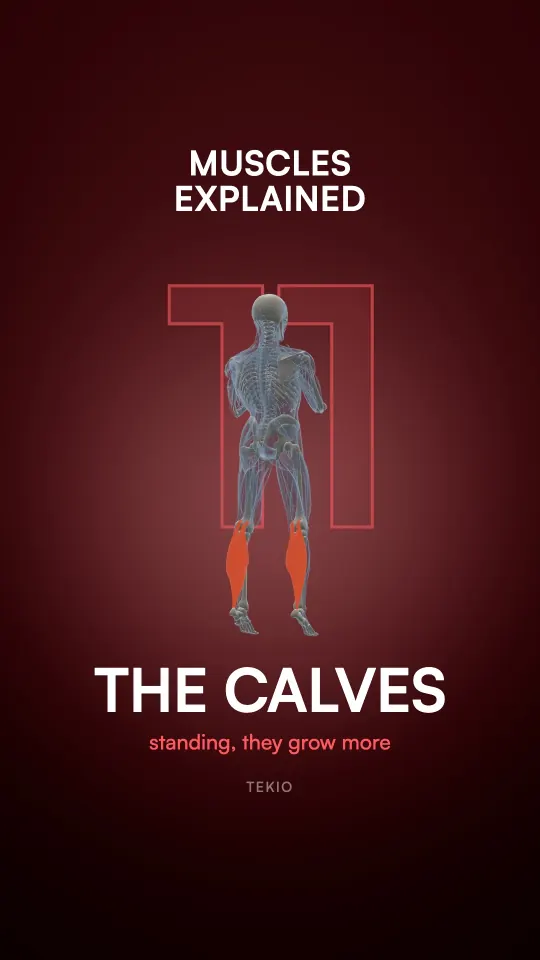
Which muscles make up your calf?
What you see of your calf is the gastrocnemius, or gastrocs: they start on your femur, above your knee, so they cross your knee too. Underneath, hidden, the soleus starts below your knee, on your tibia and fibula, the bones of your lower leg: it only crosses the ankle (Kinoshita et al., 2023).
And it’s the biggest: on MRI, in 13 men, the soleus made up 52% of the calf’s volume, the medial gastrocnemius 32% and the lateral 16% (Albracht et al., 2008). All three end on your calcaneus, your heel bone, through one shared tendon: the Achilles tendon (Doral et al., 2010).
What do the calves do?
They raise you onto your toes: that’s plantar flexion. Their tendon runs behind your ankle: as they shorten, they pull your heel up.
The gastrocs also cross behind your knee: when it bends, they go slack from the top. The soleus starts below the knee: bent or straight, nothing changes for it.
So you push less with your knee bent: in 30 men, on a measuring device, plantar flexion force was 31% lower with the knee bent to 90° than with the leg straight, and the medial gastrocnemius worked 35% less, with no compensation from the soleus (Kovács et al., 2024). The more the knee bends, the more it drops: in 10 men, with the knee deeply bent, only 60% of the straight-leg force was left (Cresswell et al., 1995).
Standing or seated calf raises: which grows them?
On the seated calf raise, your knee is bent: your gastrocs stay slack. On the standing calf raise, your leg is straight: they’re pulled from the top.
In 14 beginners, 7 women and 7 men, one leg trained standing, knee straight, the other seated, knee at 90°, 5 sets of 10 at 70% of max, twice a week for twelve weeks. On MRI, the lateral gastrocnemius grew 12.4% standing versus 1.7% seated, the medial 9.2% versus 0.6%: seated, the gastrocs didn’t grow significantly. The whole calf: +5.6% versus +2.1% (Kinoshita et al., 2023).
A sign it’s the knee: the soleus, which doesn’t cross it, grew the same both ways, 2 to 3%.
Why do calves grow so slowly?
In this study, the whole calf grew 2 to 6% in twelve weeks, while other studies measure 9 to 20% in the hamstrings or triceps (cited by Kinoshita et al., 2023). The authors’ proposed explanation: these are antigravity muscles, already used every day, known to be less prone to growth. Limits: beginners, twelve weeks.
Your workout plan, built for your body.
In Tekio, your plan targets your calves and you watch them progress on your body, week after week.

Sources
Studies checked in PubMed. Measured muscle activity isn’t growth: each fact keeps its study’s population and limits.
- Kinoshita M, Maeo S, Kobayashi Y, et al. (2023). Triceps surae muscle hypertrophy is greater after standing vs. seated calf-raise training. Front Physiol 14:1272106. PubMed · DOI
- Albracht K, Arampatzis A, Baltzopoulos V (2008). Assessment of muscle volume and physiological cross-sectional area of the human triceps surae muscle in vivo. J Biomech 41(10):2211-8. PubMed · DOI
- Doral MN, Alam M, Bozkurt M, et al. (2010). Functional anatomy of the Achilles tendon. Knee Surg Sports Traumatol Arthrosc 18(5):638-43. PubMed · DOI
- Kovács B, Csala D, Yang S, et al. (2024). Knee position affects medial gastrocnemius and soleus activation during dynamic plantarflexion: no evidence for an inter-muscle compensation in healthy young adults. Biol Open 13(12):bio061810. PubMed · DOI
- Cresswell AG, Löscher WN, Thorstensson A (1995). Influence of gastrocnemius muscle length on triceps surae torque development and electromyographic activity in man. Exp Brain Res 105(2):283-90. PubMed · DOI
These lessons inform; they don’t replace advice from a health professional.