Muscles, explained · Lesson 10
Seated or lying leg curl: which grows your hamstrings?
The seated leg curl: in 20 untrained adults, over twelve weeks, the hamstrings grew 14% on the leg trained seated, versus 9% on the leg trained lying. Your bent hip makes the difference: it pulls from the top on the three hamstrings that start on your ischium.
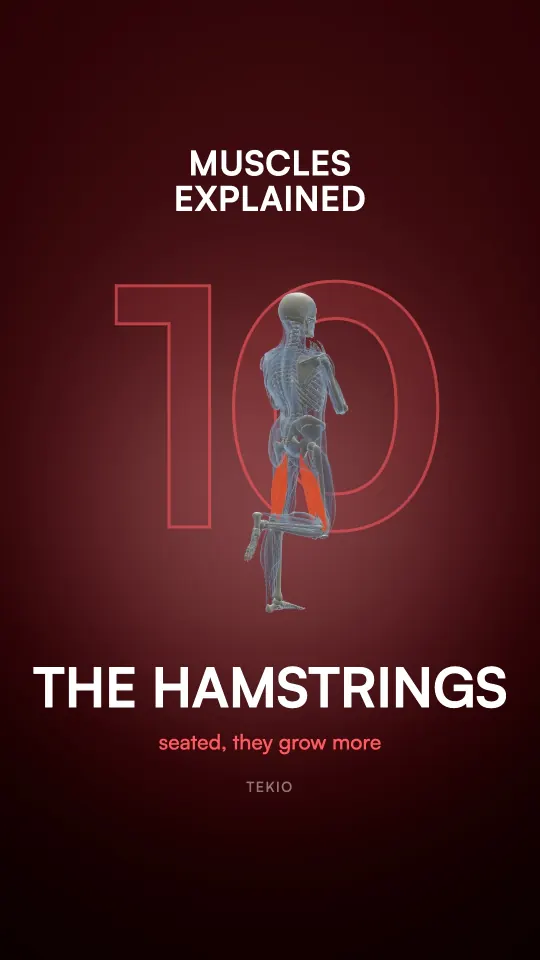
Where do the hamstrings start?
Your hamstrings are three muscles behind your thigh: the biceps femoris on the outside, the semitendinosus and the semimembranosus on the inside. They cross two joints, your hip and your knee (Linklater et al., 2010).
The biceps femoris has two heads: the long one starts on your ischium, the pelvic bone you sit on, like the semitendinosus and the semimembranosus (Maeo et al., 2021); the short one starts on your femur, your thigh bone, and it’s the only hamstring that crosses just one joint, the knee (Woodley and Mercer, 2005).
What do the hamstrings do?
They bend your knee: that’s knee flexion. They run behind it: as they shorten, they pull your lower leg back. The ones that start on your ischium also cross behind your hip and straighten it: that’s hip extension.
That’s why the back of your thighs pulls when you bend forward with straight legs: hip bent and knee straight, your hamstrings are pulled at both ends. The sit-and-reach test, seated with straight legs and reaching for your feet, is actually used to estimate their flexibility, with moderate validity according to a meta-analysis of 34 studies (Mayorga-Vega et al., 2014). The short head doesn’t cross the hip: it only bends your knee.
Seated or lying leg curl for your hamstrings?
On the lying leg curl, your hip is almost straight: your hamstrings stay short. On the seated leg curl, it’s bent: they stay pulled from the top.
In 20 young adults who hadn’t lifted for at least a year, one leg trained seated (hip bent to about 90°), the other lying (bent only 30°, that is 150° between torso and thigh), knee from 0 to 90°, 5 sets of 10 at 70% of max, twice a week for twelve weeks. On MRI, their hamstrings grew 14% seated versus 9% lying; the long head, 14% versus 6.5%, about twice as much; the semitendinosus, 24% versus 19%; the semimembranosus, 8% versus 4% (Maeo et al., 2021).
The sign it’s the hip: the short head, which doesn’t cross it, grew the same both ways (+10% versus +9%).
Does the seated leg curl protect against injury?
The biceps femoris is the hamstring that gets injured most: in pro soccer players, 84% of 255 hamstring injuries hit it (Ekstrand et al., 2016). But seated or lying, the leg curl protected just as well against muscle damage from a session where you only lower the weight (Maeo et al., 2021): no promise to make about injuries.
Are squats and hip thrusts enough for your hamstrings?
They barely grow them: no change in volume after ten weeks of squats in 17 men (Kubo et al., 2019), little to no growth after nine weeks of squats or hip thrusts in 34 beginners (Plotkin et al., 2023).
A hip extension exercise counts too: in 30 recreational athletes split into three groups of 10, ten weeks of hip extensions grew the long head more than Nordic curls (Bourne et al., 2017).
Limits: these were beginners, over twelve weeks. Not every gym machine has these angles: look for a leg curl where your hip is well bent.
Your workout plan, built for your body.
In Tekio, your plan targets your hamstrings and you watch them progress on your body, week after week.

Sources
Studies checked in PubMed. Measured muscle activity isn’t growth: each fact keeps its study’s population and limits.
- Linklater JM, Hamilton B, Carmichael J, et al. (2010). Hamstring injuries: anatomy, imaging, and intervention. Semin Musculoskelet Radiol 14(2):131-61. PubMed · DOI
- Maeo S, Huang M, Wu Y, et al. (2021). Greater Hamstrings Muscle Hypertrophy but Similar Damage Protection after Training at Long versus Short Muscle Lengths. Med Sci Sports Exerc 53(4):825-837. PubMed · DOI
- Woodley SJ, Mercer SR (2005). Hamstring muscles: architecture and innervation. Cells Tissues Organs 179(3):125-41. PubMed · DOI
- Mayorga-Vega D, Merino-Marban R, Viciana J (2014). Criterion-Related Validity of Sit-and-Reach Tests for Estimating Hamstring and Lumbar Extensibility: a Meta-Analysis. J Sports Sci Med 13(1):1-14. PubMed
- Ekstrand J, Lee JC, Healy JC (2016). MRI findings and return to play in football: a prospective analysis of 255 hamstring injuries in the UEFA Elite Club Injury Study. Br J Sports Med 50(12):738-43. PubMed · DOI
- Kubo K, Ikebukuro T, Yata H (2019). Effects of squat training with different depths on lower limb muscle volumes. Eur J Appl Physiol 119(9):1933-1942. PubMed · DOI
- Plotkin DL, Rodas MA, Vigotsky AD, et al. (2023). Hip thrust and back squat training elicit similar gluteus muscle hypertrophy and transfer similarly to the deadlift. Front Physiol 14:1279170. PubMed · DOI
- Bourne MN, Duhig SJ, Timmins RG, et al. (2017). Impact of the Nordic hamstring and hip extension exercises on hamstring architecture and morphology: implications for injury prevention. Br J Sports Med 51(5):469-477. PubMed · DOI
These lessons inform; they don’t replace advice from a health professional.