Muscles, explained · Lesson 9
Leg extension or leg press: which grows your quads?
Both grow your vasti just as much, but only leg extensions really grew the rectus femoris: +13% versus +1% with the leg press, over twelve weeks, in 17 beginners. Keep your leg press or squat for your vasti, and add leg extensions for your rectus femoris.
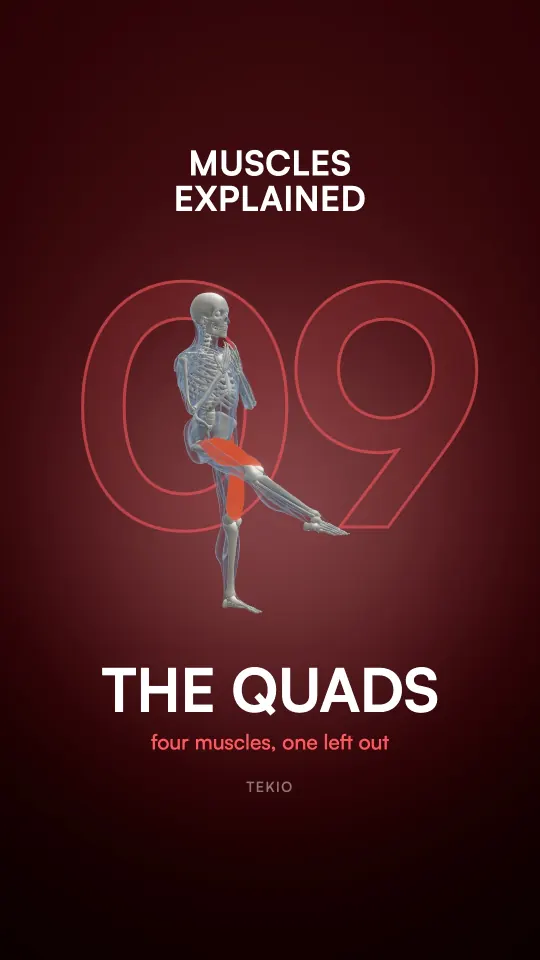
How many muscles are in your quads?
Your quads are four muscles at the front of your thigh, joined at your kneecap: their shared tendon attaches to it, then the patellar tendon carries on to your shin bone (Dwek and Chung, 2008).
Three start on your femur, your thigh bone: these are the vasti, on the outside (vastus lateralis), the inside (vastus medialis) and underneath (vastus intermedius) (Grob et al., 2017). The fourth, the rectus femoris, starts on your pelvis and runs down the middle, on top of them (Ryan et al., 2014). The three vasti make up about 85% of your quad volume (Kinoshita et al., 2026).
What do the quads do?
All four straighten your knee: that’s knee extension. They run in front of your knee, through your kneecap: as they shorten, they pull your shin forward (Dwek and Chung, 2008).
The rectus femoris also crosses the front of your hip: it helps lift your thigh, that’s hip flexion. The three vasti only cross the knee (Kinoshita et al., 2026).
Leg extension or leg press for your quads?
On the leg extension, your hip doesn’t move: the rectus femoris only has to straighten your knee. On the leg press, hip and knee straighten together: it straightens the knee, but pulls your hip the other way. In 11 men, during a set of 10 at 50% of max, it was only just over half as active on the leg press (22% of its maximum activity, versus 38% on the leg extension), while the vasti were just as active on both (Kinoshita et al., 2026). The authors think the body holds back its activation: that’s their explanation, while the lower activity itself was measured.
In 17 beginners, one leg on the leg press, the other on the leg extension, 5 sets of 10 at 70% of max, twice a week for twelve weeks, measured on MRI: the rectus femoris grew 13% with leg extensions, versus 1%, not significant, with the leg press. The three vasti grew just as much with both, 4 to 7%, and the whole quad almost as much (+7% versus +5%), since the vasti make up most of it (Kinoshita et al., 2026).
The leg press also grew muscles that leg extensions don’t touch: the gluteus maximus (+15%) and the adductor magnus (+6%). The authors call it very time-efficient, and leg extensions “essential” for the rectus femoris, the quad muscle that gets injured most often.
Does the squat grow the rectus femoris?
No more than the leg press: in 17 men, ten weeks of squats grew the knee extensors by about 5%, without changing the size of the rectus femoris (Kubo et al., 2019). The other way around, in 11 young men, twelve weeks of knee extensions grew it proportionally more than the vasti (Wakahara et al., 2017). Cyclists and rowers, who straighten hip and knee together, have big vasti and a rectus femoris similar to untrained people’s (studies cited by Kinoshita et al., 2026).
Limits: these trials were in beginners. In trained lifters, an ultrasound study cited by the same authors also found more rectus femoris growth with leg extensions, but more vastus lateralis growth with the leg press.
Your workout plan, built for your body.
In Tekio, your plan targets your quads and you watch them progress on your body, week after week.

Sources
Studies checked in PubMed. Measured muscle activity isn’t growth: each fact keeps its study’s population and limits.
- Dwek JR, Chung CB (2008). The patellar extensor apparatus of the knee. Pediatr Radiol 38(9):925-35. PubMed · DOI
- Grob K, Gilbey H, Manestar M, et al. (2017). The Anatomy of the Articularis Genus Muscle and Its Relation to the Extensor Apparatus of the Knee. JB JS Open Access 2(4):e0034. PubMed · DOI
- Ryan JM, Harris JD, Graham WC, et al. (2014). Origin of the direct and reflected head of the rectus femoris: an anatomic study. Arthroscopy 30(7):796-802. PubMed · DOI
- Kinoshita M, Maeo S, Kobayashi Y, et al. (2026). Hypertrophic Effects of Single- versus Multi-Joint Exercise: A Direct Comparison between Knee Extension and Leg Press. Med Sci Sports Exerc 58(7):1566-1580. PubMed · DOI
- Kubo K, Ikebukuro T, Yata H (2019). Effects of squat training with different depths on lower limb muscle volumes. Eur J Appl Physiol 119(9):1933-1942. PubMed · DOI
- Wakahara T, Ema R, Miyamoto N, et al. (2017). Inter- and intramuscular differences in training-induced hypertrophy of the quadriceps femoris: association with muscle activation during the first training session. Clin Physiol Funct Imaging 37(4):405-412. PubMed · DOI
These lessons inform; they don’t replace advice from a health professional.