Muscles, explained · Lesson 8
Hip thrust or squat: which grows your glutes more?
Both about equally: in 34 beginners, nine weeks of hip thrusts or squats grew the gluteus maximus the same, even though everyone felt the hip thrust far more. The squat also grew the quads, and neither really grew the gluteus medius or minimus. Keep one exercise where your hip extends, and add one where your leg moves out.
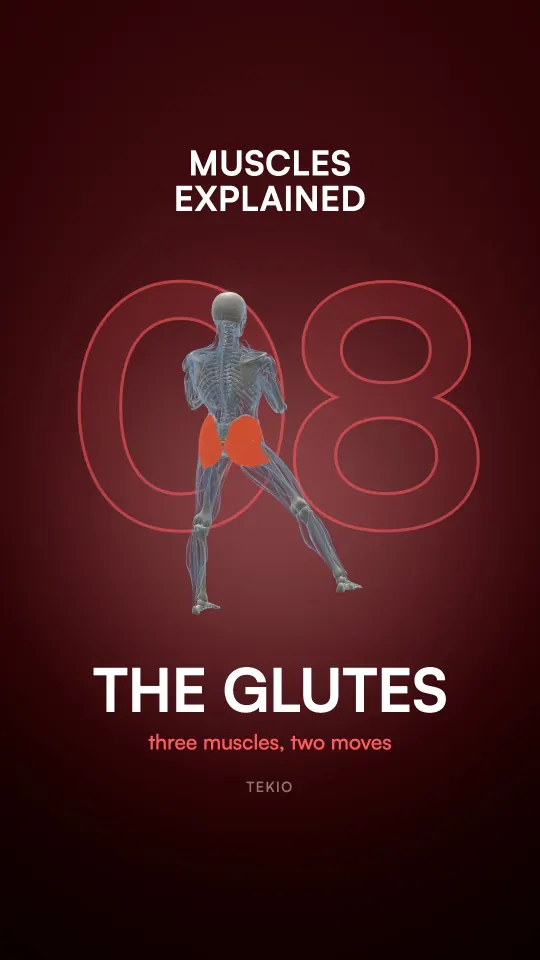
How many glute muscles are there?
Your glutes are three muscles stacked in layers: the gluteus maximus on the surface, the gluteus medius and minimus on the side of your hip (Flack et al., 2012). The gluteus maximus runs from your pelvis and your sacrum, at the base of your spine, to your femur, your thigh bone (Barker et al., 2014; Lin et al., 2025).
It’s a big muscle: on MRI, in 17 untrained young adults, it was about 840 cm³, the biggest of the 17 hip and thigh muscles measured. That’s nearly one and a half times the biggest quad, the vastus lateralis (about 580 cm³), and more than twice the medius and minimus combined (about 375 cm³) (Kinoshita et al., 2026).
What do the glutes do?
The gluteus maximus pulls your thigh backward: that’s hip extension. It runs behind your hip: as it shortens, it pulls your femur back.
The medius and minimus move your leg out to the side: that’s hip abduction. They can also help steady your pelvis when you walk (Flack et al., 2012). In 10 healthy adults, once these two muscles were paralyzed by a nerve block (after a block of the tensor fasciae latae), 5 could no longer stand 10 seconds on one leg; the authors add that a weak gluteus maximus can produce the same signs (Schmid et al., 2026).
Hip thrust or squat for your glutes?
In the hip thrust, you feel your glutes far more: in 34 beginners aged 18 to 30, everyone said so, and during a set of 10, the electrical activity of their glutes was higher than in the squat at every site measured (Plotkin et al., 2023).
Yet that didn’t make them grow more: after nine weeks with equal sets, measured on MRI, gluteus maximus growth was the same at the top, middle and bottom. Electrical activity didn’t predict who grew the most. Feeling a muscle or activating it isn’t the same as growing it.
The squat, where your knee bends too, also grew the quads and the adductors. Each group got stronger mostly in its own lift: +63% on the hip thrust in the hip thrust group, +44% on the squat in the squat group (Plotkin et al., 2023).
How do you grow the gluteus medius?
Neither the hip thrust nor the squat really grew it: little to no growth of the medius and minimus in either group (Plotkin et al., 2023). Neither one moves the leg out.
In 17 young adults, one leg did cable hip abduction, the other cable hip extension, for ten weeks. Medius and minimus: +4% with abduction, a small effect, versus +2%, not significant, with extension. That’s less than half of what the gluteus maximus gained with extension (+9%); abduction grew it 5%, mostly its upper part (Attarieh et al., 2026). So with the same abduction, all three grew about the same: the study doesn’t say whether that small number comes from the muscle or from the exercise.
Lying on your side, raising your leg: that’s where the gluteus medius was most active among 12 exercises tested in 21 healthy, active people (Distefano et al., 2009). That’s measured activity, not growth.
Your workout plan, built for your body.
In Tekio, your plan targets your glutes and you watch them progress on your body, week after week.

Sources
Studies checked in PubMed. Measured muscle activity isn’t growth: each fact keeps its study’s population and limits.
- Flack NA, Nicholson HD, Woodley SJ (2012). A review of the anatomy of the hip abductor muscles, gluteus medius, gluteus minimus, and tensor fascia lata. Clin Anat 25(6):697-708. PubMed · DOI
- Barker PJ, Hapuarachchi KS, Ross JA, et al. (2014). Anatomy and biomechanics of gluteus maximus and the thoracolumbar fascia at the sacroiliac joint. Clin Anat 27(2):234-40. PubMed · DOI
- Lin JL, Holmes A, Lynch J, et al. (2025). A safe technique in performing gluteus maximus tenotomy in the Kocher-Langenbeck approach. Hip Int 35(6):643-649. PubMed · DOI
- Kinoshita M, Maeo S, Kobayashi Y, et al. (2026). Hypertrophic Effects of Single- versus Multi-Joint Exercise: A Direct Comparison between Knee Extension and Leg Press. Med Sci Sports Exerc 58(7):1566-1580. PubMed · DOI
- Schmid M, Hoch A, Dimitriou D, et al. (2026). Evaluation of Trendelenburg and Duchenne signs by experimentally induced gluteal muscle paralysis. Clin Biomech (Bristol) 139:106931. PubMed · DOI
- Plotkin DL, Rodas MA, Vigotsky AD, et al. (2023). Hip thrust and back squat training elicit similar gluteus muscle hypertrophy and transfer similarly to the deadlift. Front Physiol 14:1279170. PubMed · DOI
- Attarieh P, Nunes JP, Khani S, et al. (2026). Regional Hypertrophy of the Gluteal Muscles Is Task-Specific: Differential Responses to 10 Weeks of Hip Extension Versus Hip Abduction Training. J Strength Cond Res Epub 2026 Oct 7. PubMed · DOI
- Distefano LJ, Blackburn JT, Marshall SW, et al. (2009). Gluteal muscle activation during common therapeutic exercises. J Orthop Sports Phys Ther 39(7):532-40. PubMed · DOI
These lessons inform; they don’t replace advice from a health professional.