Muscles, explained · Lesson 7
Abs: can you really target your lower or upper abs?
No: your six-pack is a single muscle, the rectus abdominis, and it works as a block. In 11 athletes, its top and bottom worked just as hard, in crunches and leg raises alike. To train it, curl your spine: in a crunch, your ribs come toward your pelvis; in a reverse crunch, your pelvis comes toward your ribs.
What makes a six-pack?
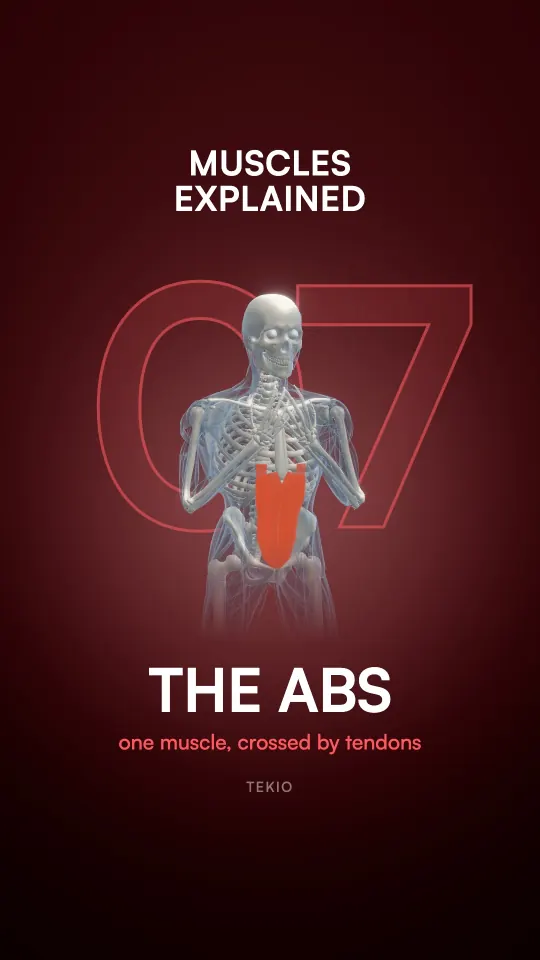
Your abs are mostly the rectus abdominis: a band of muscle on each side of your navel, from your ribs to your pubis, the bone at the front of your pelvis. Three or four bands of tendon cut across it: these are the tendinous intersections. In 32 dissected bodies, 30 had three pairs and 2 had four; in 54 others, 52 had three, one had four, one had five (Broyles et al., 2018; Anita et al., 2015).
Between them, the muscle tends to be thicker than at the bands (Broyles et al., 2018): that bulge is what makes your six-pack. On your sides, the obliques turn your torso: during a static twisting effort, they were the muscles working hardest (Pope et al., 1987).
What does the rectus abdominis do?
It pulls your ribs toward your pelvis: that’s trunk flexion. It runs in front of your spine (Reid and Costigan, 1987; Jorgensen et al., 2005): as it shortens, it curls it forward.
But it stops at your pelvis: it doesn’t bend your hip.
Do full sit-ups work your abs?
In a full sit-up, once your spine is curled, it’s your hip that bends, and the psoas, a hip muscle, takes over. In 8 adults, the psoas worked at 15 to 35% of its max in every form of sit-up, vs under 10% in the crunch (Juker et al., 1998).
Do ab exercises burn belly fat?
No. In 24 sedentary adults, 6 weeks of 7 ab exercises, 5 days a week, on an unchanged calorie intake, changed neither belly fat, nor waist size, nor weight (Vispute et al., 2011).
That fat is a reserve for your whole body: it doesn’t drop more where you train. In 104 adults who trained only one arm for 12 weeks, MRI showed general fat loss, no greater on the trained arm; only the skinfold caliper, in men, saw it drop on the trained arm and not the other (Kostek et al., 2007).
Can you target your lower abs?
To train it, curl your spine: in a crunch, your ribs come toward your pelvis; in a reverse crunch, your pelvis comes toward your ribs. But it’s one single muscle: in 11 athletes, the top and bottom of the rectus worked just as hard, in crunches and leg raises alike (Lehman and McGill, 2001). That’s measured muscle activity: the study says nothing about one part growing more.
Your workout plan, built for your body.
In Tekio, your plan targets your abs and you watch them progress on your body, week after week.

Sources
Studies checked in PubMed. Measured muscle activity isn’t growth: each fact keeps its study’s population and limits.
- Broyles JM, Schuenke MD, Patel SR, et al. (2018). Defining the Anatomy of the Tendinous Intersections of the Rectus Abdominis Muscle and Their Clinical Implications in Functional Muscle Neurotization. Ann Plast Surg 80(1):50-53. PubMed · DOI
- Anita, Haque M, Gupta A, et al. (2015). Variation in Tendinous Intersections of Rectus Abdominis Muscle in North Indian Population with Clinical Implications. J Clin Diagn Res 9(6):AC10-2. PubMed · DOI
- Pope MH, Svensson M, Andersson GB, et al. (1987). The role of prerotation of the trunk in axial twisting efforts. Spine (Phila Pa 1976) 12(10):1041-5. PubMed · DOI
- Reid JG, Costigan PA (1987). Trunk muscle balance and muscular force. Spine (Phila Pa 1976) 12(8):783-6. PubMed · DOI
- Jorgensen MJ, Marras WS, Smith FW, et al. (2005). Sagittal plane moment arms of the female lumbar region rectus abdominis in an upright neutral torso posture. Clin Biomech (Bristol) 20(3):242-6. PubMed · DOI
- Juker D, McGill S, Kropf P, et al. (1998). Quantitative intramuscular myoelectric activity of lumbar portions of psoas and the abdominal wall during a wide variety of tasks. Med Sci Sports Exerc 30(2):301-10. PubMed · DOI
- Vispute SS, Smith JD, LeCheminant JD, et al. (2011). The effect of abdominal exercise on abdominal fat. J Strength Cond Res 25(9):2559-64. PubMed · DOI
- Kostek MA, Pescatello LS, Seip RL, et al. (2007). Subcutaneous fat alterations resulting from an upper-body resistance training program. Med Sci Sports Exerc 39(7):1177-85. PubMed · DOI
- Lehman GJ, McGill SM (2001). Quantification of the differences in electromyographic activity magnitude between the upper and lower portions of the rectus abdominis muscle during selected trunk exercises. Phys Ther 81(5):1096-101. PubMed · DOI
These lessons inform; they don’t replace advice from a health professional.