Deep muscles · Lesson 6
Quadratus lumborum: what does it do and how do you train it?
Your quadratus lumborum bends your torso to its side and, with your obliques, stops you from leaning when a load pulls you the other way. To train it, do side planks with the top leg raised: that’s where it worked hardest, out of 14 planks, in 13 men. And for your back, two loads beat one: 30 kg (66 lb) in one hand loaded it almost twice as much as 15 kg (33 lb) in each hand.
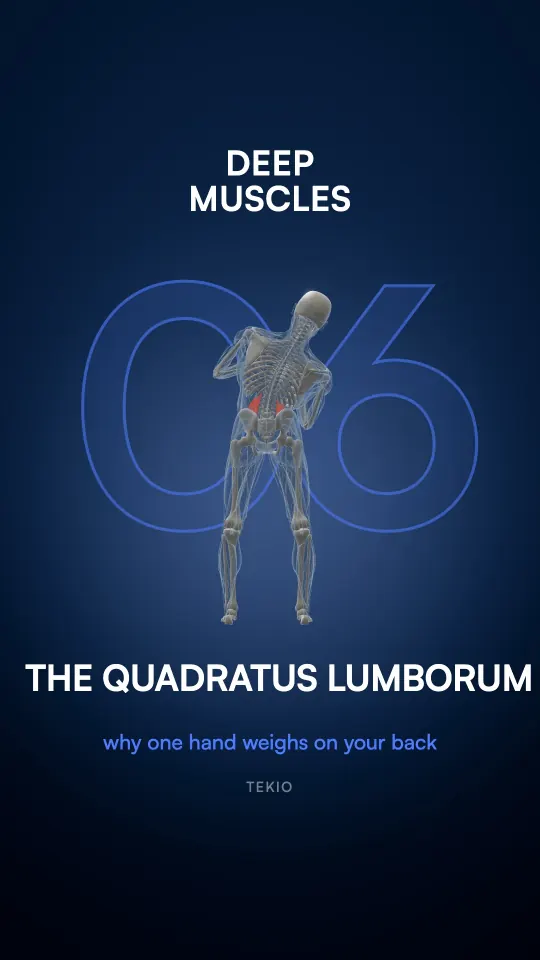
Where is the quadratus lumborum?
You have one on each side of your lower back. It starts at the top of your pelvis and runs up to your lowest rib: in 6 dissected cadavers, about half its bundles acted on the 12th rib, and the rest on the lumbar vertebrae (Phillips et al., 2008). In 18 others, it attached to the outer edge of their transverse processes, the small bony wings on each side of the vertebra (Barker et al., 2007).
Its bundles vary a lot in number and size, from one person to the next and even from one side to the other (Phillips et al., 2008).
What does the quadratus lumborum do?
When one shortens, your torso leans toward it: that’s lateral flexion of the trunk. In 9 adults, fine-wire electrodes placed in its two layers found both more active when bending the torso sideways; the back layer was also active when straightening the back (Park et al., 2013). Its sideways force is modest: in a model built from the dissections, it exerts no more than 10% of that of the spinal erectors and multifidus (Phillips et al., 2008).
But when a load pulls you to one side, it stops you from leaning. During a very heavy yoke carry, a strongman event, the hip didn’t have the strength to hold the pelvis on its own: muscles like the quadratus lumborum made up for it by holding the torso and pelvis sideways (McGill et al., 2009). In 4 young adults, it worked at 74% of its max on average during heavy lifts, with a barbell up to 70 kg (154 lb) (McGill et al., 1996).
Why does carrying in one hand load your back more?
In 6 young men walking with buckets, a spine model fed by electrodes, force plates and motion tracking calculated the load on the low back: with 30 kg (66 lb) in one hand, over 2,800 newtons of compression; with 15 kg (33 lb) in each hand, 1,570, or 44% less; and even with 30 kg in each hand, less than with 30 kg in one (McGill et al., 2013).
The load pulls your torso toward it: to keep you upright, the muscles on the other side pull back. In 5 men carrying a bag on their left shoulder, the sideways effort at the low back shifted to the right (DeVita et al., 1991). In 27 adults, a dumbbell held in the right hand made the trunk muscles on the left work harder, abs and back, and vice versa; the quadratus lumborum wasn’t measured (Paek et al., 2022).
And as these muscles pull, they squeeze your spine: on the yoke carry, the highest spine load came from the weight plus the strong contraction of the trunk muscles (McGill et al., 2009). With a load in each hand, the two sides balance out.
On stairs too, the same load, 20% of body weight, carried on one side demanded more sideways effort at the low back than split between both hands (Wang and Gillette, 2018). This is about carrying: in 30 adults, lifting and lowering with one hand compressed the spine less than with two, but sheared it more sideways (Weston et al., 2020).
Which exercise works the quadratus lumborum?
The side plank: in 4 young adults, it was more active there than the other muscles measured, and the authors recommend it to train this muscle (McGill et al., 1996). In 13 men, fine-wire electrodes placed in its two layers tracked 14 kinds of plank: it worked hardest in the side plank with the top leg raised (Oshikawa et al., 2020).
If you can’t bear weight on your elbow, lifting your torso while lying on your side on a 45° bench worked it as much as a side plank, in 20 men, measured with surface electrodes (Choi et al., 2020).
That’s activity, not growth: no study has yet measured which exercise makes the quadratus lumborum grow.
Your workout plan, built for your body.
In your Tekio session, on side planks, raise that top leg.

Sources
Studies checked in PubMed. Measured muscle activity isn’t growth: each fact keeps its study’s population and limits.
- McGill SM, Marshall L, Andersen J (2013). Low back loads while walking and carrying: comparing the load carried in one hand or in both hands. Ergonomics 56(2):293-302. PubMed · DOI
- Oshikawa T, Adachi G, Akuzawa H, et al. (2020). Change in Regional Activity of the Quadratus Lumborum During Bridge Exercises. J Sport Rehabil 30(2):226-234. PubMed · DOI
- Phillips S, Mercer S, Bogduk N (2008). Anatomy and biomechanics of quadratus lumborum. Proc Inst Mech Eng H 222(2):151-9. PubMed · DOI
- Barker PJ, Urquhart DM, Story IH, et al. (2007). The middle layer of lumbar fascia and attachments to lumbar transverse processes: implications for segmental control and fracture. Eur Spine J 16(12):2232-7. PubMed · DOI
- Park RJ, Tsao H, Claus A, et al. (2013). Changes in regional activity of the psoas major and quadratus lumborum with voluntary trunk and hip tasks and different spinal curvatures in sitting. J Orthop Sports Phys Ther 43(2):74-82. PubMed · DOI
- McGill S, Juker D, Kropf P (1996). Quantitative intramuscular myoelectric activity of quadratus lumborum during a wide variety of tasks. Clin Biomech (Bristol) 11(3):170-172. PubMed · DOI
- McGill SM, McDermott A, Fenwick CM (2009). Comparison of different strongman events: trunk muscle activation and lumbar spine motion, load, and stiffness. J Strength Cond Res 23(4):1148-61. PubMed · DOI
- DeVita P, Hong D, Hamill J (1991). Effects of asymmetric load carrying on the biomechanics of walking. J Biomech 24(12):1119-29. PubMed · DOI
- Paek S, Kang J, Shin B, et al. (2022). Changes in Trunk Muscle Activity during Unilateral Weight Bearing and Abnormal Postural Gait in Healthy Individuals. Medicina (Kaunas) 58(12):1800. PubMed · DOI
- Wang J, Gillette JC (2018). Carrying asymmetric loads during stair negotiation: Loaded limb stance vs. unloaded limb stance. Gait Posture 64:213-219. PubMed · DOI
- Weston EB, Aurand AM, Dufour JS, et al. (2020). One versus two-handed lifting and lowering: lumbar spine loads and recommended one-handed limits protecting the lower back. Ergonomics 63(4):505-521. PubMed · DOI
- Choi CW, Koo JW, Jeong YG (2020). Comparison of Trunk Muscle Activity During Modified Side-Bridge Exercises and Traditional Side Bridge Exercise. J Sport Rehabil 29(7):963-969. PubMed · DOI
These lessons inform; they don’t replace advice from a health professional.