Deep muscles · Lesson 5
Leg raises: abs or psoas, which muscle does the work?
Your hip flexors lift your legs: your psoas and the iliacus, helped by the rectus femoris. Your abs work to hold your pelvis. To make your psoas work harder, take your legs all the way up: in 9 men, its activity kept rising to the end of the movement, while the rectus femoris’s didn’t.
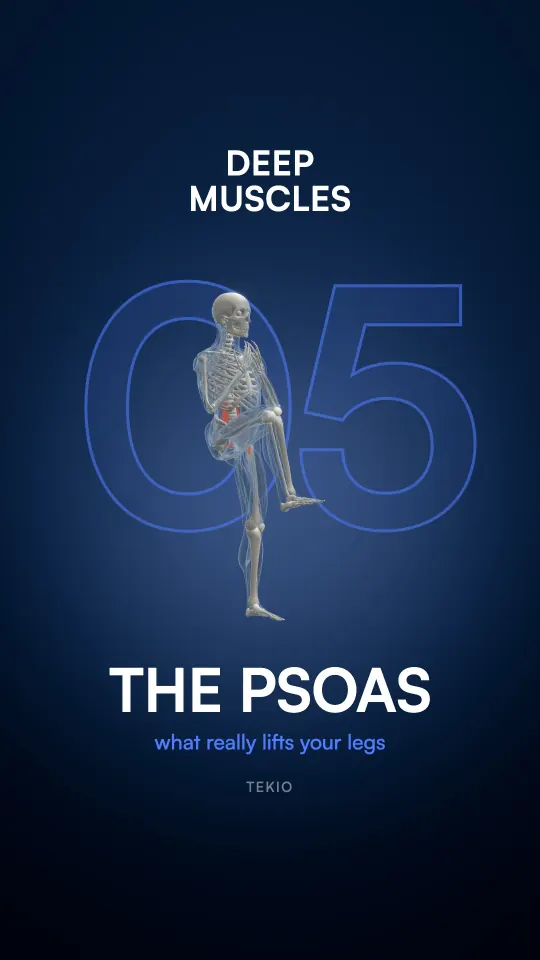
Where is the psoas?
Your psoas starts on the vertebrae of your lower back, from their bodies, discs and transverse processes, deep inside your belly. It joins the iliacus, the muscle lining the hollow of your pelvis, and their shared tendon, the iliopsoas tendon, attaches on the lesser trochanter, a bump at the top of your thighbone (Juan et al., 2024). On the way, it runs in front of your hip (Tramer et al., 2024).
On your spine, it barely moves anything: in a model built from 3 dissections and X-rays of 10 men, its moments on the lumbar vertebrae were very small; at maximum contraction, though, it compresses them strongly (Bogduk et al., 1992).
What does the psoas do?
When it shortens, your thigh comes up: that’s hip flexion, the main job of the psoas and iliacus (Tramer et al., 2024).
It pulls your thigh forward with every step: in 11 adults, fine-wire electrodes found it active at every stride, during hip flexion, and its activity rose sharply above 2 m/s, about 4.5 mph (Andersson et al., Acta Physiol Scand, 1997). In 56 sprinters it was bigger than in 40 non-sprinters, and its size went with a faster 100 m; but almost all their muscles were bigger: a link, not proof (Tottori et al., 2021).
Do your abs lift your legs?
No: in 6 men, the hip flexors only worked hard when the hip bent; the abs kicked in when both legs were lifted together, not just one (Andersson et al., Eur J Appl Physiol, 1997).
So why do you feel them? As your leg rises, the hip flexors tip your pelvis forward. In 17 women doing a straight leg raise, electrodes found the belly wall active: according to the authors, to stop that tilt (Hu et al., 2010).
And “lower abs”? In 11 athletes, the top and bottom of the rectus abdominis worked the same, leg raises included (Lehman and McGill, 2001).
How do you train the psoas?
In 9 men, a fine electrode inside the psoas tracked the straight leg raised to the end of hip flexion. Its activity peaked late in the lift, during the hold at the top and early in the lowering, and beat that of the rectus femoris, the muscle at the front of the thigh, which stopped keeping up (Okubo et al., 2021).
Another team found the same in 10 men: psoas and iliacus more active with the leg raised to 60° than to 30° or 45°, the other muscles not (Yamane et al., 2019); so did a review of 9 studies (Juan et al., 2024).
That’s activity, not growth: no study has yet measured which exercise makes the psoas grow in young lifters.
Your workout plan, built for your body.
In your Tekio session, on leg raises, take them all the way up: that’s where it works hardest.

Sources
Studies checked in PubMed. Measured muscle activity isn’t growth: each fact keeps its study’s population and limits.
- Okubo Y, Kaneoka K, Hasebe K, et al. (2021). Differential activation of psoas major and rectus femoris during active straight leg raise to end range. J Electromyogr Kinesiol 60:102588. PubMed · DOI
- Yamane M, Aoki M, Sasaki Y, et al. (2019). Understanding the Muscle Activity Pattern of the Hip Flexors during Straight Leg Raising in Healthy Subjects. Prog Rehabil Med 4:20190007. PubMed · DOI
- Juan J, Leff G, Kevorken K, et al. (2024). Hip Flexor Muscle Activation During Common Rehabilitation and Strength Exercises. J Clin Med 13(21):6617. PubMed · DOI
- Andersson EA, Nilsson J, Ma Z, et al. (1997). Abdominal and hip flexor muscle activation during various training exercises. Eur J Appl Physiol Occup Physiol 75(2):115-23. PubMed · DOI
- Hu H, Meijer OG, van Dieën JH, et al. (2010). Muscle activity during the active straight leg raise (ASLR), and the effects of a pelvic belt on the ASLR and on treadmill walking. J Biomech 43(3):532-9. PubMed · DOI
- Lehman GJ, McGill SM (2001). Quantification of the differences in electromyographic activity magnitude between the upper and lower portions of the rectus abdominis muscle during selected trunk exercises. Phys Ther 81(5):1096-101. PubMed
- Andersson EA, Nilsson J, Thorstensson A (1997). Intramuscular EMG from the hip flexor muscles during human locomotion. Acta Physiol Scand 161(3):361-70. PubMed · DOI
- Tramer JS, Holmich P, Safran MR (2024). The Iliopsoas: Anatomy, Clinical Evaluation, and Its Role in Hip Pain in the Athlete: A Scoping Review. J Am Acad Orthop Surg 32(13):e620-e630. PubMed · DOI
- Bogduk N, Pearcy M, Hadfield G (1992). Anatomy and biomechanics of psoas major. Clin Biomech (Bristol) 7(2):109-19. PubMed · DOI
- Tottori N, Suga T, Miyake Y, et al. (2021). Trunk and lower limb muscularity in sprinters: what are the specific muscles for superior sprint performance? BMC Res Notes 14(1):74. PubMed · DOI
These lessons inform; they don’t replace advice from a health professional.