Deep muscles · Lesson 4
Multifidus: stability ball or deadlift to train it?
To work your multifidus, bet on load rather than instability. In 9 trained men on a stability ball, the multifidus worked at less than half of what it did in their max deadlift. These small muscles stuck to your spine are built to hold it hard: keep heavy deadlift sets.
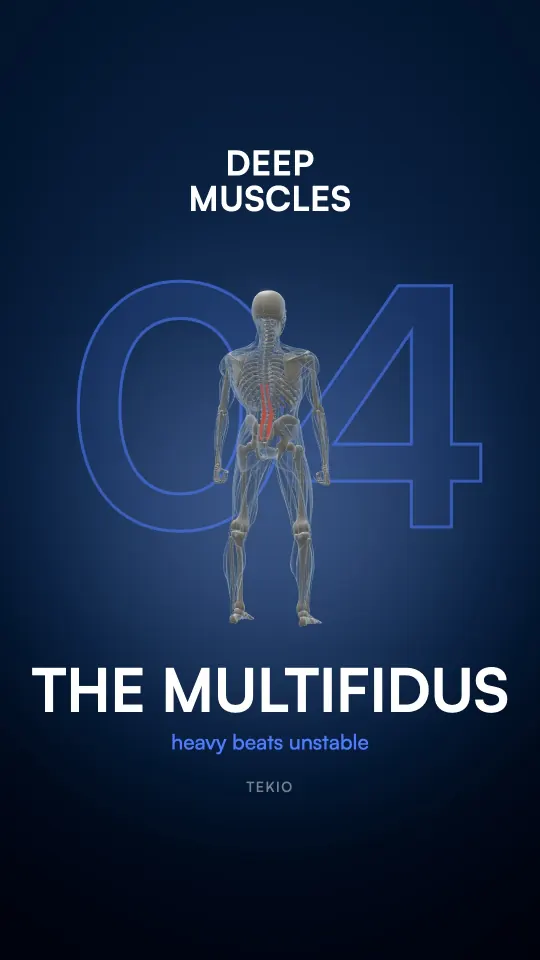
Where is the multifidus?
Your multifidus is a group of small muscles stuck to the back of your spine. In your lower back, it forms five bands: each one starts at the spinous process of a lumbar vertebra, the bony point at the back of the vertebra (Macintosh et al., 1986).
Its bundles run down to attach lower: the deepest one level lower, the middle ones three to four, the most superficial up to five (Tieppo Francio et al., 2023).
What does the multifidus do?
Its movement is extension: based on X-rays of 5 cadavers and 21 people, each bundle tips its lumbar vertebra backward, without sliding it; rotation is only a minor, secondary action (Macintosh and Bogduk, 1986).
And it’s built to hold. In the spines of 8 older donors, its fibers were only a fifth of the muscle’s length, with a large cross-section: according to the authors, a design made to stabilize the spine by producing large forces (Ward et al., 2009). In a lab, on 7 lumbar spines where a machine simulated the pull of five muscle groups, the multifidus reduced the movement of the tested vertebra the most (Wilke et al., 1995).
Stability ball or deadlift for the multifidus?
In 9 strength-trained men, electrodes stuck on the lower back measured the multifidus during three exercises held on a stability ball, then during squats and deadlifts from 50 to 100% of their max. On the ball, it worked at 30% (on all fours), 38% (bridge) and 46% (back extension) of what it did in their max deadlift: less than half. For this muscle, only the squat and deadlift at 100% beat the ball significantly (Nuzzo et al., 2008). That’s measured activity, not growth.
A review of 17 studies (252 participants), co-authored by Nuzzo, concludes with a moderate level of evidence that the multifidus works harder in free-weight exercises than on balls or devices (Martuscello et al., 2013). In 16 people, another team also found the lower back more active in squats and deadlifts at 80% of their max than in two bodyweight balance exercises, the superman and the side bridge (Hamlyn et al., 2007).
Why does heavy beat unstable?
The ball adds wobble, not weight. An unstable base lowers force, power, speed and range of motion, while ground-based free-weight exercises like squats and deadlifts work the trunk as much as or more than unstable ones (Behm et al., 2010).
The ball isn’t useless, though: on the same exercise, a meta-analysis of 28 studies found that instability makes the trunk work harder, spinal erectors included, but on a Swiss ball or with loads of 60% of max, the effect reversed for the erectors; the authors see it as useful in rehab (Bao et al., 2025).
No study has yet measured whether the deadlift makes the multifidus grow.
Does the multifidus shrink when your back goes out?
In 26 patients with recent pain on one side of the lower back, ultrasound showed a multifidus 31% smaller on the painful side, at a single vertebra, the painful one in 24 of them (Hides et al., 1994). In 50 patients who had hurt on one side for more than 12 weeks, another team found smaller muscles on the painful side on MRI, multifidus and psoas (Barker et al., 2004); in 14 active people who had hurt on one side for over a year, it was smaller on both sides (Beneck and Kulig, 2012).
It’s a link, not a cause, and it’s not a treatment: with back pain, see a physio.
Your workout plan, built for your body.
In your Tekio session, on the deadlift, keep your heavy sets: that’s where they work.

Sources
Studies checked in PubMed. Measured muscle activity isn’t growth: each fact keeps its study’s population and limits.
- Nuzzo JL, McCaulley GO, Cormie P, et al. (2008). Trunk muscle activity during stability ball and free weight exercises. J Strength Cond Res 22(1):95-102. PubMed · DOI
- Martuscello JM, Nuzzo JL, Ashley CD, et al. (2013). Systematic review of core muscle activity during physical fitness exercises. J Strength Cond Res 27(6):1684-98. PubMed · DOI
- Hamlyn N, Behm DG, Young WB (2007). Trunk muscle activation during dynamic weight-training exercises and isometric instability activities. J Strength Cond Res 21(4):1108-12. PubMed · DOI
- Behm DG, Drinkwater EJ, Willardson JM, et al. (2010). Canadian Society for Exercise Physiology position stand: The use of instability to train the core in athletic and nonathletic conditioning. Appl Physiol Nutr Metab 35(1):109-12. PubMed · DOI
- Bao Z, Wang S, Li Z (2025). Effects of unstable training on muscle activation: a systematic review and meta-analysis of electromyographic studies. PeerJ 13:e19751. PubMed · DOI
- Ward SR, Kim CW, Eng CM, et al. (2009). Architectural analysis and intraoperative measurements demonstrate the unique design of the multifidus muscle for lumbar spine stability. J Bone Joint Surg Am 91(1):176-85. PubMed · DOI
- Wilke HJ, Wolf S, Claes LE, et al. (1995). Stability increase of the lumbar spine with different muscle groups. A biomechanical in vitro study. Spine (Phila Pa 1976) 20(2):192-8. PubMed · DOI
- Macintosh JE, Valencia F, Bogduk N, et al. (1986). The morphology of the human lumbar multifidus. Clin Biomech (Bristol) 1(4):196-204. PubMed · DOI
- Macintosh JE, Bogduk N (1986). The biomechanics of the lumbar multifidus. Clin Biomech (Bristol) 1(4):205-13. PubMed · DOI
- Tieppo Francio V, Westerhaus BD, Carayannopoulos AG, et al. (2023). Multifidus dysfunction and restorative neurostimulation: a scoping review. Pain Med 24(12):1341-1354. PubMed · DOI
- Hides JA, Stokes MJ, Saide M, et al. (1994). Evidence of lumbar multifidus muscle wasting ipsilateral to symptoms in patients with acute/subacute low back pain. Spine (Phila Pa 1976) 19(2):165-72. PubMed · DOI
- Barker KL, Shamley DR, Jackson D (2004). Changes in the cross-sectional area of multifidus and psoas in patients with unilateral back pain: the relationship to pain and disability. Spine (Phila Pa 1976) 29(22):E515-9. PubMed · DOI
- Beneck GJ, Kulig K (2012). Multifidus atrophy is localized and bilateral in active persons with chronic unilateral low back pain. Arch Phys Med Rehabil 93(2):300-6. PubMed · DOI
These lessons inform; they don’t replace advice from a health professional.