Deep muscles · Lesson 8
Do squats and deadlifts build your neck muscles?
Barely. Over twelve weeks of squats, deadlifts and other big lifts, active students grew their quads by 7%, but their necks barely grew at all. Those who added three sets of ten weighted neck extensions grew theirs by 13%. Your neck needs an exercise of its own.
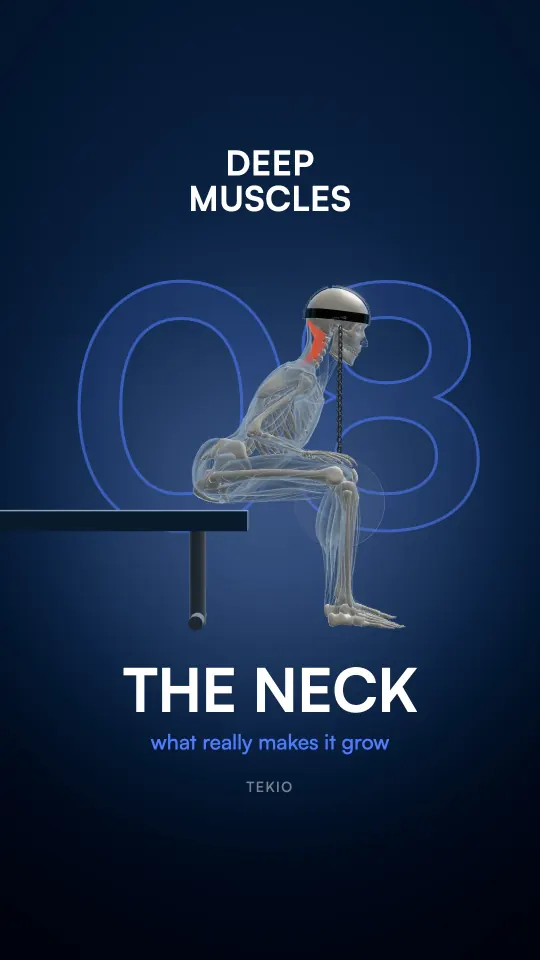
Which muscles make up your neck?
At the back, your splenius and semispinalis muscles start on the vertebrae of your neck and upper back, then climb up to attach to the back of your skull; the splenius capitis reaches behind your ear (De La Paz et al., 2023, 20 dissections).
In front, your sternocleidomastoid runs from your breastbone and collarbone up to behind your ear as well.
What do your neck muscles do?
When you lift your head, they’re the ones pulling: that’s extension. In 7 adults scanned by MRI after each head movement, the splenius capitis and the semispinalis muscles worked hardest to lift it; to lower it, flexion, it was the sternocleidomastoid and the deep muscles at the front of the neck (Conley et al., 1995).
And the ones at the back work all day long. Your head and neck weigh about 7% of your body, so 4 to 5 kg (9 to 11 lb) for someone weighing 60 to 70 kg (130 to 155 lb) (de Leva, 1996): that weight pulls your head forward, and they’re what holds it back. The more you tilt it, the harder they work: on a tablet, the demand on the neck was 3 to 5 times that of an upright head (Vasavada et al., 2015). In 25 smartphone users, glasses that spared them from looking down reduced both neck flexion and neck muscle activity (Tang et al., 2021).
Do squats and deadlifts grow your neck?
Barely. Researchers used MRI to measure the necks of 22 active students, men and women, before and after 12 weeks of 3 sessions a week. One group did squats, deadlifts, push presses, bent-over rows and mid-thigh pulls: their quads grew by 7%, proof the training was working, but the area of their neck muscles went from 19.6 to 19.7 cm² (Conley et al., 1997).
The authors’ explanation: in those lifts, the load sits on your shoulders or in your hands. Your neck contracts without moving to hold your head and carries only its weight, like all day long: a modest load.
Which exercise builds your neck?
Weighted neck extensions. In the same study, another group did the same program plus three sets of ten head extensions, three times a week, with the load of their three-sets-of-ten max. Their necks went from 19.5 to 22.0 cm², 13% more, and their splenius and semispinalis grew by about 24%; their exercise load went from 17.9 to 23.9 kg (about 39 to 53 lb) (Conley et al., 1997).
These are small groups (6 and 8 people) and a single trial. Another team also saw the neck muscles of 26 women grow after ten weeks of neck training, twice a week (Kramer et al., 2013).
Your workout plan, built for your body.
In your Tekio session, after your deadlifts, add those three sets of neck extensions.

Sources
Studies checked in PubMed. Measured muscle activity isn’t growth: each fact keeps its study’s population and limits.
- Conley MS, Stone MH, Nimmons M, et al. (1997). Specificity of resistance training responses in neck muscle size and strength. Eur J Appl Physiol Occup Physiol 75(5):443-8. PubMed · DOI
- Conley MS, Meyer RA, Bloomberg JJ, et al. (1995). Noninvasive analysis of human neck muscle function. Spine (Phila Pa 1976) 20(23):2505-12. PubMed · DOI
- De La Paz JS, Buckley HR, Halcrow SE, et al. (2023). Architecture of head and neck soft tissues and associated entheses: An exploration of sexual dimorphism in, and population differences between, New Zealand and Thai individuals. J Anat 243(1):110-127. PubMed · DOI
- de Leva P (1996). Adjustments to Zatsiorsky-Seluyanov's segment inertia parameters. J Biomech 29(9):1223-30. PubMed · DOI
- Vasavada AN, Nevins DD, Monda SM, et al. (2015). Gravitational demand on the neck musculature during tablet computer use. Ergonomics 58(6):990-1004. PubMed · DOI
- Tang M, Sommerich CM, Lavender SA (2021). An investigation of an ergonomics intervention to affect neck biomechanics and pain associated with smartphone use. Work 69(1):127-139. PubMed · DOI
- Kramer M, Hohl K, Bockholt U, et al. (2013). Training effects of combined resistance and proprioceptive neck muscle exercising. J Back Musculoskelet Rehabil 26(2):189-97. PubMed · DOI
These lessons inform; they don’t replace advice from a health professional.