Hypertrophy, explained · Lesson 1
Mechanical tension: what actually makes a muscle grow?
The tension in its fibers, not the weight itself. When your muscle contracts, its fibers pull on your bones: that force is tension, and sensors in each fiber turn it into a growth signal. In thirteen people, an arm bent with no load at all, biceps squeezed as hard as possible, grew as much as the other arm, which did heavy curls; the loaded arm, though, gained twice as much strength.
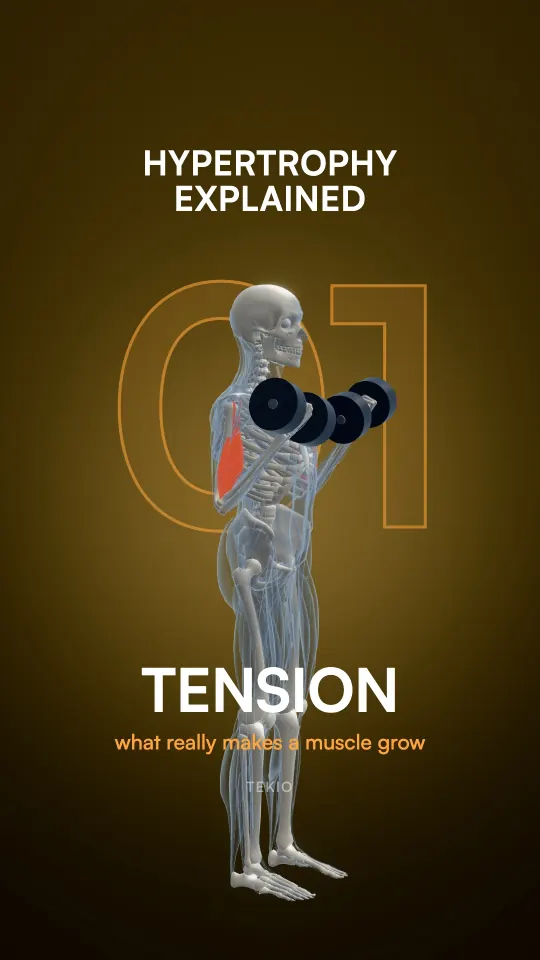
What is mechanical tension?
When your biceps contracts, its fibers pull on your bones: that force is tension. Your muscle doesn’t know how heavy your dumbbell is; what it feels is that tension.
A 2010 review lists three factors that can play a role in muscle growth: mechanical tension, muscle damage and metabolic stress (Schoenfeld, 2010). A more recent review names mechanical signals as the prime candidates for triggering it (Wackerhage et al., 2019).
How does tension make a muscle grow?
Inside each fiber, sensors pick up the tension. When it’s high, they switch on protein building: the fiber adds protein and grows, that’s hypertrophy. This building runs mainly through a pathway called mTORC1, but not only; the exact sensors aren’t all known yet, and fatigue-related pathways exist, with more indirect evidence (Wackerhage et al., 2019).
Why does high tension take real effort?
Because your body switches on its smallest, weakest motor units first, and the biggest ones only when the effort demands it (Henneman, 1957). In 10 trained men, muscle samples showed that sets taken to failure worked both slow and fast fibers, whether the load was heavy or light (Morton et al., 2019).
Can a muscle grow with no weight at all?
In one study, yes. In 13 people, over 18 sessions, one arm did curls at 70% of its max, while the other bent the elbow with no load, squeezing the biceps as hard as possible. The muscle thickened the same on both sides, but curl max went up 2.3 kg (5 lb) with the load, versus 1 kg (2 lb) without (Counts et al., 2016). A small trial, on a single muscle.
Across 21 studies where every set went to failure, growth was the same with light or heavy loads, and maximal strength rose more with heavy ones (Schoenfeld et al., 2017). So the weight isn’t useless: it builds more strength.
As for post-workout hormones, their rise doesn’t tell who will grow. In 12 young men, the arm trained right before a hard leg workout, which raised those hormones, grew no more than the other (West et al., 2010); in 49 trained men, their rise after the session was linked neither to muscle nor to strength gains (Morton et al., 2016).
Should you think about your muscle during the set?
On curls, yes. In 30 beginner men, over 8 weeks of 4 sets of 8 to 12 reps, those who focused on squeezing the biceps saw it thicken by 12.4%, versus 6.9% for those who focused on lifting the weight; for the thighs, no difference (Schoenfeld et al., 2018).
In 18 trained men on the bench press, focusing on one muscle raised its activity up to 60% of max, but no longer at 80% (Calatayud et al., 2016).
Your workout plan, built for your body.
In Tekio, an easy set counts less for your biceps than a hard one.

Sources
Studies checked in PubMed. Measured muscle activity isn’t growth: each fact keeps its study’s population and limits.
- Schoenfeld BJ (2010). The mechanisms of muscle hypertrophy and their application to resistance training. J Strength Cond Res 24(10):2857-72. PubMed · DOI
- Wackerhage H, Schoenfeld BJ, Hamilton DL, et al. (2019). Stimuli and sensors that initiate skeletal muscle hypertrophy following resistance exercise. J Appl Physiol (1985) 126(1):30-43. PubMed · DOI
- Henneman E (1957). Relation between size of neurons and their susceptibility to discharge. Science 126(3287):1345-7. PubMed · DOI
- Morton RW, Sonne MW, Farias Zuniga A, et al. (2019). Muscle fibre activation is unaffected by load and repetition duration when resistance exercise is performed to task failure. J Physiol 597(17):4601-4613. PubMed · DOI
- Counts BR, Buckner SL, Dankel SJ, et al. (2016). The acute and chronic effects of "NO LOAD" resistance training. Physiol Behav 164(Pt A):345-52. PubMed · DOI
- Schoenfeld BJ, Grgic J, Ogborn D, et al. (2017). Strength and Hypertrophy Adaptations Between Low- vs. High-Load Resistance Training: A Systematic Review and Meta-analysis. J Strength Cond Res 31(12):3508-3523. PubMed · DOI
- Schoenfeld BJ, Vigotsky A, Contreras B, et al. (2018). Differential effects of attentional focus strategies during long-term resistance training. Eur J Sport Sci 18(5):705-712. PubMed · DOI
- Calatayud J, Vinstrup J, Jakobsen MD, et al. (2016). Importance of mind-muscle connection during progressive resistance training. Eur J Appl Physiol 116(3):527-33. PubMed · DOI
- West DW, Burd NA, Tang JE, et al. (2010). Elevations in ostensibly anabolic hormones with resistance exercise enhance neither training-induced muscle hypertrophy nor strength of the elbow flexors. J Appl Physiol (1985) 108(1):60-7. PubMed · DOI
- Morton RW, Oikawa SY, Wavell CG, et al. (2016). Neither load nor systemic hormones determine resistance training-mediated hypertrophy or strength gains in resistance-trained young men. J Appl Physiol (1985) 121(1):129-38. PubMed · DOI
These lessons inform; they don’t replace advice from a health professional.