Muscles, explained · Lesson 3
Delts: which exercises actually build wider shoulders?
For wider shoulders, do lateral raises: the side head of your deltoid is what makes you wide, and the bench press grows it less than every other muscle it works. Your deltoid has three heads pulling your arm in three directions: presses build the front, lateral raises the side, and pulls work the rear.
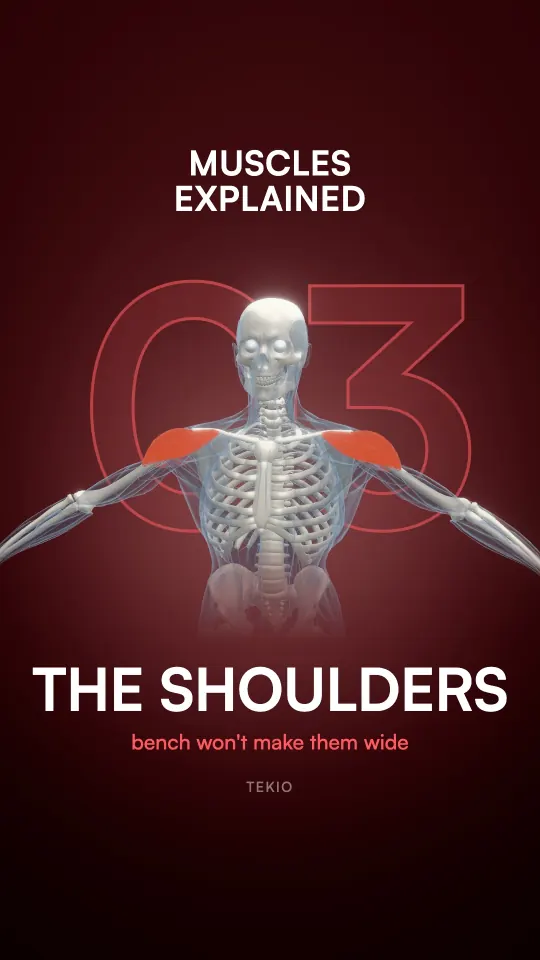
Which muscle shapes your shoulder?
Your shoulder is the deltoid, shaped like a delta, the Greek triangle. Of the 32 muscles crossing the shoulder, elbow and wrist, it has the largest share of the volume: 15.2%, according to MRI scans of 10 adults, short and tall (Holzbaur et al., 2007).
It has three heads: the front starts on your collarbone, the side on your shoulder tip, the rear on your shoulder blade. All three meet in the middle of your upper arm.
What does each head of the deltoid do?
Each one pulls the middle of your arm toward where it starts. The front raises your arm in front of you: that’s shoulder flexion. The side lifts it out to the side: that’s abduction. The rear pulls your raised arm back: that’s horizontal abduction.
The side head has its fibers packed like a feather, and it’s the part of the deltoid with the biggest lever for lifting your arm out; the front and rear, strap-like, have more leverage for raising your arm in front of you and pulling it back (Gorelick and Brown, 2007).
Does the bench press work your shoulders?
It works the front: pushing forward is its move, which is why you feel the front of your shoulders after chest day. 13 men benched for 10 weeks, 3 times a week, while 11 others did nothing. On MRI, the pecs, front delts and triceps grew more than in the controls; the side delt grew less than every other muscle measured (Lanza et al., 2024).
How do you get wider shoulders?
The side head is what makes you wide, and it needs its own move: lifting your arm out. In 24 trained men and women, 8 weeks of lateral raises, 2 sessions a week, thickened it by 3.3 to 4.6%, just as much on the arm doing them with a dumbbell as on the arm doing them on a cable (Larsen et al., 2025).
Which exercises work the rear delts?
The rear head fires most on pulls. A review of 33 studies ranking exercises by measured activity puts pull-ups on top; exercise by exercise, the standard pull-up and the bodyweight inverted row on a suspension trainer come first. The side head fires most on lateral raises and reverse flyes; the front head on flyes, especially incline (Rabello et al., 2024). That’s muscle activity, not growth.
Your workout plan, built for your body.
In Tekio, your plan targets your shoulders and you watch them progress on your body, week after week.

Sources
Studies checked in PubMed. Measured muscle activity isn’t growth: each fact keeps its study’s population and limits.
- Holzbaur KR, Murray WM, Gold GE, et al. (2007). Upper limb muscle volumes in adult subjects. J Biomech 40(4):742-9. PubMed · DOI
- Gorelick ML, Brown JM (2007). Mechanomyographic assessment of contractile properties within seven segments of the human deltoid muscle. Eur J Appl Physiol 100(1):35-44. PubMed · DOI
- Lanza MB, Prado GC, Lacerda LT, et al. (2024). Muscle hypertrophy response across four muscles involved in the bench press exercise: Randomized 10 weeks training intervention. J Bodyw Mov Ther 40:1417-1422. PubMed · DOI
- Larsen S, Wolf M, Schoenfeld BJ, et al. (2025). Dumbbell versus cable lateral raises for lateral deltoid hypertrophy: an experimental study. Front Physiol 16:1611468. PubMed · DOI
- Rabello R, Bertozzi F, Hauschild de Freitas IL, et al. (2024). Activation of the three deltoid muscle portions during common strengthening exercises: A systematic review. J Bodyw Mov Ther 40:1309-1325. PubMed · DOI
These lessons inform; they don’t replace advice from a health professional.