Muscles, explained · Lesson 4
Biceps: incline curl or preacher curl, which is better?
Keep both: on the incline curl, arm behind you, your biceps grows a bit more; on the preacher curl, arm in front of you, it’s the brachialis, the muscle hidden under your biceps. In 21 beginners, after 12 weeks, the muscles that bend the elbow had grown just as much on both sides.
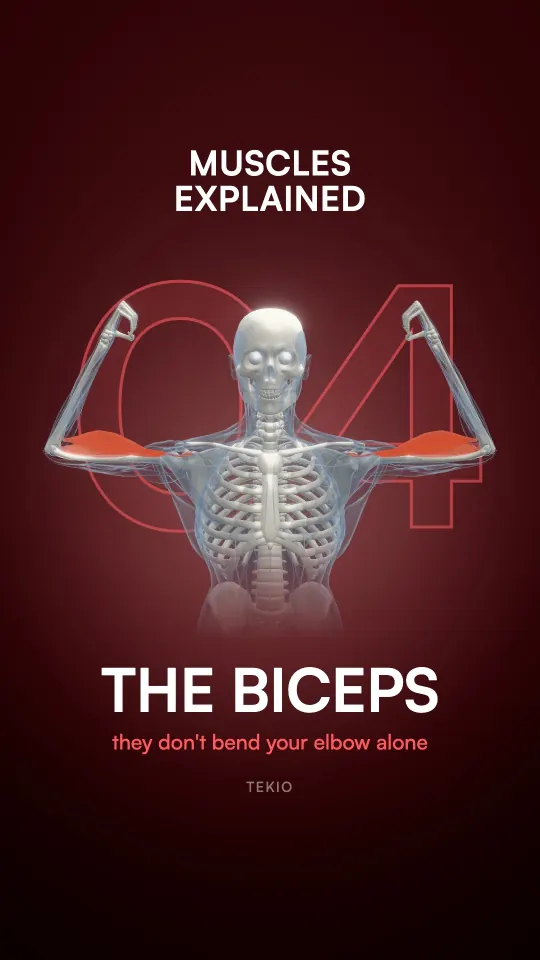
Is the biceps the only muscle that bends the elbow?
No. When you bend your elbow, your biceps provides only about a third of the force; nearly half comes from a muscle hidden underneath, the brachialis. In 4 men scanned with MRI, each muscle’s share of elbow flexion force, estimated from its cross-section and its lever arm, was 47% for the brachialis, 34% for the biceps and 19% for the brachioradialis, on the forearm (Kawakami et al., 1994).
Where do the biceps and brachialis attach?
Biceps means two heads: both start on your shoulder blade and run across the front of your shoulder. At the bottom, it attaches to the radius, the forearm bone that rotates.
The brachialis starts on your humerus, your upper arm bone, and attaches to the other forearm bone, the ulna, the one that doesn’t rotate.
Why does your biceps squeeze harder palm up?
Both bend your elbow: that’s elbow flexion. But the biceps, hooked to the radius, also turns your palm up: that’s supination. In 14 people, during static efforts, adding an upward palm rotation to an elbow-bending effort sharply raised biceps activity, while brachialis activity dropped a little (Buchanan et al., 1989). That’s muscle activity, not growth.
And only the biceps crosses the shoulder: where your arm is stretches it or slackens it.
Incline curl or preacher curl?
21 beginners did 12 weeks of dumbbell curls, twice a week, one arm on incline curls, arm behind the body, the other on preacher curls, arm in front. On MRI, the biceps grew 22.1% vs 18.9%, the brachialis 17.1% vs 21.1%, and the elbow flexors as a whole 17.6% vs 19.2%, with no clear difference (Kobayashi et al., 2026). A single, very recent study, with small to moderate gaps.
On cables, when resistance is matched in both positions, two other trials find no clear difference: arm behind vs arm by your side in 24 untrained men (Larsen et al., 2026), arm in front vs arm behind in 15 young men (Attarieh et al., 2025).
Do pulldowns grow your biceps?
Yes: in 29 untrained young men, 10 weeks of lat pulldowns alone thickened the elbow flexors as much as 10 weeks of curls alone, 6.10% vs 5.83% (Gentil et al., 2015).
Your workout plan, built for your body.
In Tekio, your plan targets your biceps and you watch them progress on your body, week after week.

Sources
Studies checked in PubMed. Measured muscle activity isn’t growth: each fact keeps its study’s population and limits.
- Kawakami Y, Nakazawa K, Fujimoto T, et al. (1994). Specific tension of elbow flexor and extensor muscles based on magnetic resonance imaging. Eur J Appl Physiol Occup Physiol 68(2):139-47. PubMed · DOI
- Buchanan TS, Rovai GP, Rymer WZ (1989). Strategies for muscle activation during isometric torque generation at the human elbow. J Neurophysiol 62(6):1201-12. PubMed · DOI
- Kobayashi Y, Maeo S, Eihara Y, et al. (2026). Exercise-specific preferential hypertrophy of individual elbow flexor muscles after incline versus preacher dumbbell curl training. J Sports Sci 1-14. PubMed · DOI
- Larsen S, Sandvik Kristiansen B, Østerås Sandberg N, et al. (2026). The effects of shoulder extension angle on elbow flexor hypertrophy in the cable curl exercise. Front Physiol 17:1750722. PubMed · DOI
- Attarieh P, Nunes JP, Khani S, et al. (2025). Comparison Between Shoulder Flexed and Extended Positions in Elbow Flexion Resistance Training on Regional Hypertrophy and Maximum Strength: Preacher versus Bayesian Cable Curls. Eur J Sport Sci 25(4):e12279. PubMed · DOI
- Gentil P, Soares S, Bottaro M (2015). Single vs. Multi-Joint Resistance Exercises: Effects on Muscle Strength and Hypertrophy. Asian J Sports Med 6(2):e24057. PubMed · DOI
These lessons inform; they don’t replace advice from a health professional.