The right exercise · Lesson 5
Leg extension: upright or reclined backrest for your quads?
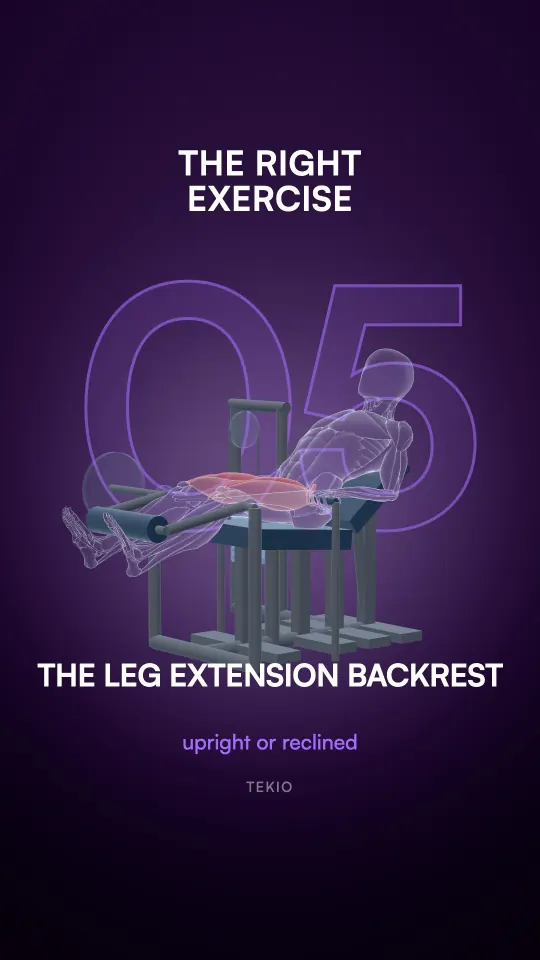
Reclined, for the muscle down the middle of your thigh. In 22 untrained men over 10 weeks, the rectus femoris grew thicker on the leg trained with the hip bent to 40°, torso leaning back, than on the leg trained sitting upright, hip at 90°; the vastus lateralis, on the side of the thigh, grew just as much on both. So recline your backrest, about halfway between sitting and lying down.
Why does the backrest change how your quads work?
Your quads are four muscles at the front of your thigh. The rectus femoris, the one in the middle, starts on your pelvis through two tendons, one just above your hip, the other on the rim of its socket (Ryan et al., 2014). So it crosses the front of your hip and the front of your knee: it straightens your knee and helps lift your thigh, that’s hip flexion. The three vasti only cross the knee (Kinoshita et al., 2026).
Sitting upright, your hip is bent: the two ends of the rectus femoris come closer, so it works shortened. Recline the backrest and your hip opens, so it lengthens (Kinoshita et al., 2026). The vasti, which don’t cross the hip, stay the same length whatever the backrest.
It’s also the muscle that brings your thigh forward when you run: in 15 sprinters, only rectus femoris volume was linked to their speed and to how hard they flexed the hip of the leg swinging forward (Ema et al., 2018). That’s a link, not proof.
Reclined backrest: does the rectus femoris work harder?
Yes, according to MRI. 9 bodybuilders did 4 sets of 10 at 70% of their max on the leg extension, with the hip bent at 80°, at 40° or flat (0°). After the sets, MRI showed more work in the upper and middle rectus femoris at 40° and flat than at 80° (Mitsuya et al., 2023). That’s a sign of how hard it worked during the sets, not a measure of growth.
And what you feel isn’t enough to judge: the contraction the bodybuilders reported feeling didn’t match what the MRI showed (Mitsuya et al., 2023).
Upright or reclined: which grows your quads?
As far as we know, only one study has compared the two settings in training. 22 untrained men did leg extensions twice a week for 10 weeks, one leg with the hip bent at 90°, sitting upright, the other at 40°, with the side for each setting picked at random. The thickness of the rectus femoris and vastus lateralis was measured by ultrasound at two points along the thigh (Larsen et al., 2025).
The rectus femoris grew thicker on the 40° leg, at both points: evidence the authors call “extreme.” The vastus lateralis grew just as much on both sides, with “strong” evidence of no difference. Their conclusion: both settings can work for growing your quads, but to grow the rectus femoris as much as possible in untrained men, they suggest bending the hip less (Larsen et al., 2025).
Sitting upright, the leg extension still pays off: in 17 beginners, hip at 90°, the rectus femoris gained 13% in volume on MRI over 12 weeks, versus 1% with the leg press. The authors think a less bent hip might have grown it more; that’s their hypothesis, which they didn’t test (Kinoshita et al., 2026).
Does a stretched muscle always grow more?
Not as a general rule. Across 12 studies in young adults, training a muscle at longer or shorter lengths grew it about the same; the authors note that the lengths compared often differed only a little, by 21.8% on average, and urge caution (Varovic et al., 2025). A review of 8 studies leans toward the stretched muscle, but calls the evidence mixed (Wolf et al., 2026).
So what the backrest study shows holds for this muscle, in this study: untrained men, 10 weeks, thickness measured at two points rather than the muscle’s volume (Larsen et al., 2025). And in 39 young men after 15 weeks of leg training, ultrasound thickness was not a reliable index of the growth measured on MRI (Balshaw et al., 2026).
Your workout plan, built for your body.
In Tekio, your plan targets your quads and you watch them progress on your body, week after week.

Sources
Studies checked in PubMed. Measured muscle activity isn’t growth: each fact keeps its study’s population and limits.
- Ryan JM, Harris JD, Graham WC, et al. (2014). Origin of the direct and reflected head of the rectus femoris: an anatomic study. Arthroscopy 30(7):796-802. PubMed · DOI
- Kinoshita M, Maeo S, Kobayashi Y, et al. (2026). Hypertrophic Effects of Single- versus Multi-Joint Exercise: A Direct Comparison between Knee Extension and Leg Press. Med Sci Sports Exerc 58(7):1566-1580. PubMed · DOI
- Ema R, Sakaguchi M, Kawakami Y (2018). Thigh and Psoas Major Muscularity and Its Relation to Running Mechanics in Sprinters. Med Sci Sports Exerc 50(10):2085-2091. PubMed · DOI
- Mitsuya H, Nakazato K, Hakkaku T, et al. (2023). Hip flexion angle affects longitudinal muscle activity of the rectus femoris in leg extension exercise. Eur J Appl Physiol 123(6):1299-1309. PubMed · DOI
- Larsen S, Sandvik Kristiansen B, Swinton PA, et al. (2025). The effects of hip flexion angle on quadriceps femoris muscle hypertrophy in the leg extension exercise. J Sports Sci 43(2):210-221. PubMed · DOI
- Varovic D, Wolf M, Schoenfeld BJ, et al. (2025). Does Muscle Length Influence Regional Hypertrophy? A Systematic Review and Meta-Analysis. Int J Sports Med 46(14):1027-1036. PubMed · DOI
- Wolf M, Korakakis PA, Roberts MD, et al. (2026). Does longer-muscle length resistance training cause greater longitudinal growth in humans? A systematic review. Sports Med Health Sci 8(1):34-42. PubMed · DOI
- Balshaw TG, Funnell MP, McDermott EJ, et al. (2026). Ultrasound Muscle Thickness Is a Poor Index of Criterion Magnetic Resonance Imaging Measures of Resistance Training-Induced Muscle Growth. Med Sci Sports Exerc 58(11):2466-2476. PubMed · DOI
These lessons inform; they don’t replace advice from a health professional.