The right exercise · Lesson 4
Flat or incline bench press: which builds the upper chest?
For your upper chest, go incline. In untrained young men doing the same number of sets for 8 weeks, the top of the pectoralis major thickened about 6 mm more on the incline press than on the flat bench, with no clear gap at the two other sites measured. Make the incline your main press, bench halfway between lying and sitting, no higher.
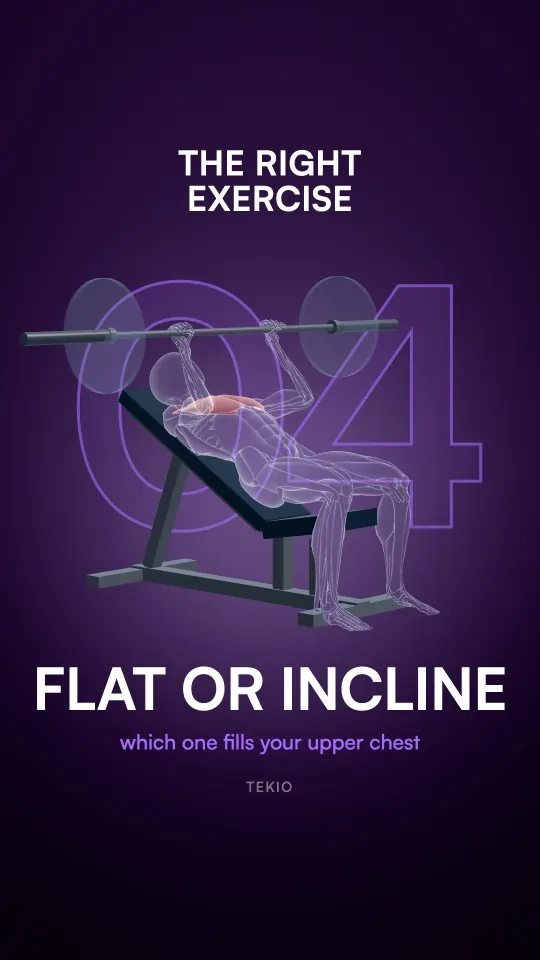
Why does an incline bench target your upper chest?
Your upper chest is the part of the pectoralis major whose fibers start on your collarbone; the rest starts on your breastbone and ribs. In 8 donor upper limbs, those top fibers were among the most effective at raising the arm in front of you, shoulder flexion; the breastbone and lower fibers mostly pulled the arm back down to your side (Ackland et al., 2008).
And the bench changes the direction you push. On a flat bench, your arms push straight out from your chest; with the bench raised, they push upward relative to your torso: your shoulder flexes, the upper chest’s move. In 15 men at 70% of their max, on four angles from 0 to 56°, the upper part fired more at 44 and 56° than on the flat bench, and the sternal part fired most on the flat bench (Trebs et al., 2010). In 8 volunteers, activity recorded at 15 points from the top to the bottom of the muscle shifted toward the upper part as the bench went from flat to 45° (Cabral et al., 2022).
That’s measured electrical activity, not growth: a muscle that works harder doesn’t necessarily grow more. Only a training study can tell.
Flat or incline: which grows your upper chest more?
To our knowledge, only one training study compares chest growth between the two. Researchers randomly split 47 untrained young men into three groups: flat bench press (15), incline bench press (15), or both (17). One session a week for 8 weeks with the same number of sets in every group; before and after, pec thickness was measured at three sites (Chaves et al., 2020).
Only one of the three sites changed differently between groups: the top, between the second and third ribs. It thickened about 6 mm more on the incline than flat, with a wide margin of uncertainty, from 2 to 10 mm. At the other two sites, no clear difference between groups (Chaves et al., 2020).
It’s a single study, in beginners, training once a week: in trained lifters, the gap may differ.
Is the flat bench press enough?
Many think so, since you press more weight there. On load, that’s true: in 12 competitive bench pressers, the 6-rep max was 18.5 to 21.5% lighter on the incline than on a flat or decline bench (Saeterbakken et al., 2017). But the weight on your bar doesn’t pick which part of the muscle grows: with equal sets, the incline is what thickened the upper chest most (Chaves et al., 2020).
The flat bench doesn’t leave your upper chest out, though. In 14 trained men at 65% of their max, the upper pec was no more active at 30 or 45° than flat over the whole push, only during its second quarter (Lauver et al., 2016); in the 12 competitors, pec activity didn’t differ clearly from one bench to another (Saeterbakken et al., 2017).
On strength, all three groups in the training study improved alike: about 10 kg (about 22 lb) on a static flat-bench push, 11 kg (about 24 lb) on an incline (Chaves et al., 2020).
How should you split your pressing sets?
The study’s third group split the same sets between flat and incline. Its upper chest thickened about 5 mm less than the incline group’s (Chaves et al., 2020): splitting the sets didn’t give the upper chest what the incline alone did. Make the incline your main press instead, the one that gets most of your sets.
Set your bench halfway between lying and sitting, no higher. Beyond that, your shoulders take over: in 30 trained lifters, past 45° the front of the shoulder was clearly more active and the pectoralis major worked less (Rodríguez-Ridao et al., 2020).
Your workout plan, built for your body.
In Tekio, your plan targets your pecs and you watch them progress on your body, week after week.

Sources
Studies checked in PubMed. Measured muscle activity isn’t growth: each fact keeps its study’s population and limits.
- Ackland DC, Pak P, Richardson M, et al. (2008). Moment arms of the muscles crossing the anatomical shoulder. J Anat 213(4):383-90. PubMed · DOI
- Trebs AA, Brandenburg JP, Pitney WA (2010). An electromyography analysis of 3 muscles surrounding the shoulder joint during the performance of a chest press exercise at several angles. J Strength Cond Res 24(7):1925-30. PubMed · DOI
- Cabral HV, de Souza LML, de Oliveira LF, et al. (2022). Non-uniform excitation of the pectoralis major muscle during flat and inclined bench press exercises. Scand J Med Sci Sports 32(2):381-390. PubMed · DOI
- Chaves SFN, Rocha-Júnior VA, Encarnação IGA, et al. (2020). Effects of Horizontal and Incline Bench Press on Neuromuscular Adaptations in Untrained Young Men. Int J Exerc Sci 13(6):859-872. PubMed · DOI
- Saeterbakken AH, Mo DA, Scott S, et al. (2017). The Effects of Bench Press Variations in Competitive Athletes on Muscle Activity and Performance. J Hum Kinet 57:61-71. PubMed · DOI
- Lauver JD, Cayot TE, Scheuermann BW (2016). Influence of bench angle on upper extremity muscular activation during bench press exercise. Eur J Sport Sci 16(3):309-16. PubMed · DOI
- Rodríguez-Ridao D, Antequera-Vique JA, Martín-Fuentes I, et al. (2020). Effect of Five Bench Inclinations on the Electromyographic Activity of the Pectoralis Major, Anterior Deltoid, and Triceps Brachii during the Bench Press Exercise. Int J Environ Res Public Health 17(19):7339. PubMed · DOI
These lessons inform; they don’t replace advice from a health professional.