Hypertrophy, explained · Lesson 5
Full or partial range of motion: which builds more muscle?
Keep the part where your muscle stretches. In 17 men, ten weeks of full squats or half squats grew the quads the same, but the glutes three times less with half squats. On the leg extension, the bent-knee half, quads stretched, grew the thigh at least as much as the full movement; the straight-knee half, at two spots out of four, no more than not training at all.
What is range of motion?
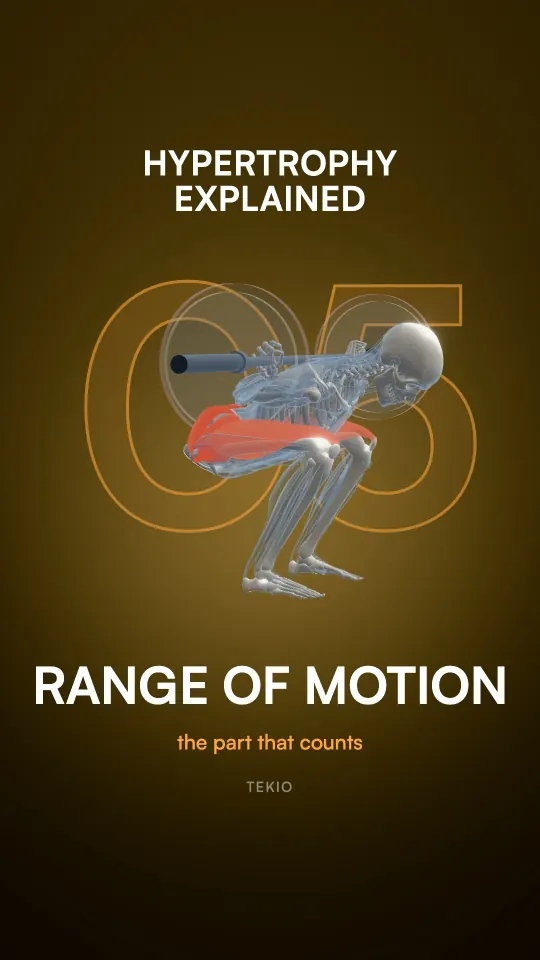
Range of motion is the path of your movement, from stretched muscle to shortened muscle. In the squat, you go down: your hips bend, your glutes stretch. You come up: your hips straighten, and they shorten.
Why does a stretched muscle grow more?
Across 8 studies, the muscle generally grew more when it trained at long lengths than at short ones; what changes inside its fibers is still unknown (Wolf et al., 2026).
The proposed explanation: stretched, your muscle pulls on the weight while also being pulled tight like a rubber band. These two tensions, active and passive, trigger a protein-building signal in the same way, hence the hypothesis that they add up (Wolf et al., 2026). It’s a hypothesis, not an established fact.
Not every result points the same way: across 12 studies, training at a longer or shorter average muscle length gave similar growth, but the differences in length tested were modest, which calls for caution (Varovic et al., 2025).
Can you do just half the movement?
Yes, if it’s the stretched half. In 45 beginner women on the leg extension, five groups: the full movement (knee from 100° to 30° of bend), the bent-knee half (100° to 65°), the straight-knee half (65° to 30°), both halves alternated, or nothing. The bent-knee half grew the thigh more than the full movement at three spots out of four; the straight-knee half, at two spots, no more than the group that didn’t train (Pedrosa et al., 2022).
More recent trials find the stretched half alone roughly equal to the full movement: in 30 trained lifters, for the arms (Wolf et al., 2025), and in 297 people across 15 gyms, for the arms and thighs (Gschneidner et al., 2025). Across 11 studies, the full movement or its stretched part grew several muscles more than the shortened part alone (Kassiano et al., 2023).
Full squat or half squat?
The half squat skips the hardest part: under heavy loads, a sticking region shows up in the full and parallel squat, but not in the half squat (Martínez-Cava et al., 2019). Yet in 17 men, ten weeks of full or half squats, twice a week: the quads grew the same (+4.9% and +4.6%), the gluteus maximus 6.7% versus 2.2% and the adductors 6.2% versus 2.7%; neither grew the hamstrings (Kubo et al., 2019).
Across 16 studies, a full range of motion built more strength and more lower-body muscle than a partial one (Pallarés et al., 2021). So go as low as you can while keeping your back straight.
Your workout plan, built for your body.
In Tekio, the simulator shows your squat’s range of motion: how far your hips and knees bend.

Sources
Studies checked in PubMed. Measured muscle activity isn’t growth: each fact keeps its study’s population and limits.
- Wolf M, Korakakis PA, Roberts MD, et al. (2026). Does longer-muscle length resistance training cause greater longitudinal growth in humans? A systematic review. Sports Med Health Sci 8(1):34-42. PubMed · DOI
- Varovic D, Wolf M, Schoenfeld BJ, et al. (2025). Does Muscle Length Influence Regional Hypertrophy? A Systematic Review and Meta-Analysis. Int J Sports Med 46(14):1027-1036. PubMed · DOI
- Pedrosa GF, Lima FV, Schoenfeld BJ, et al. (2022). Partial range of motion training elicits favorable improvements in muscular adaptations when carried out at long muscle lengths. Eur J Sport Sci 22(8):1250-1260. PubMed · DOI
- Wolf M, Androulakis Korakakis P, Piñero A, et al. (2025). Lengthened partial repetitions elicit similar muscular adaptations as full range of motion repetitions during resistance training in trained individuals. PeerJ 13:e18904. PubMed · DOI
- Gschneidner D, Carlson L, Steele J, et al. (2025). The effects of lengthened-partial range of motion resistance training of the limbs on arm and thigh muscle area: A multi-site randomised trial. J Sports Sci 43(23):2963-2976. PubMed · DOI
- Kassiano W, Costa B, Nunes JP, et al. (2023). Which ROMs Lead to Rome? A Systematic Review of the Effects of Range of Motion on Muscle Hypertrophy. J Strength Cond Res 37(5):1135-1144. PubMed · DOI
- Martínez-Cava A, Morán-Navarro R, Sánchez-Medina L, et al. (2019). Velocity- and power-load relationships in the half, parallel and full back squat. J Sports Sci 37(10):1088-1096. PubMed · DOI
- Kubo K, Ikebukuro T, Yata H (2019). Effects of squat training with different depths on lower limb muscle volumes. Eur J Appl Physiol 119(9):1933-1942. PubMed · DOI
- Pallarés JG, Hernández-Belmonte A, Martínez-Cava A, et al. (2021). Effects of range of motion on resistance training adaptations: A systematic review and meta-analysis. Scand J Med Sci Sports 31(10):1866-1881. PubMed · DOI
These lessons inform; they don’t replace advice from a health professional.