Muscles, explained · Lesson 1
Pecs: what incline bench angle builds the upper chest?
For your upper chest, set your bench around 30°, and never past 45°. At 30°, the top of the pectoralis major fires the most, by a small margin, while the middle and bottom ease off; past 45°, the front of your shoulders takes over. In beginners, eight weeks of incline pressing thickened the upper chest about 6 mm more than flat pressing.
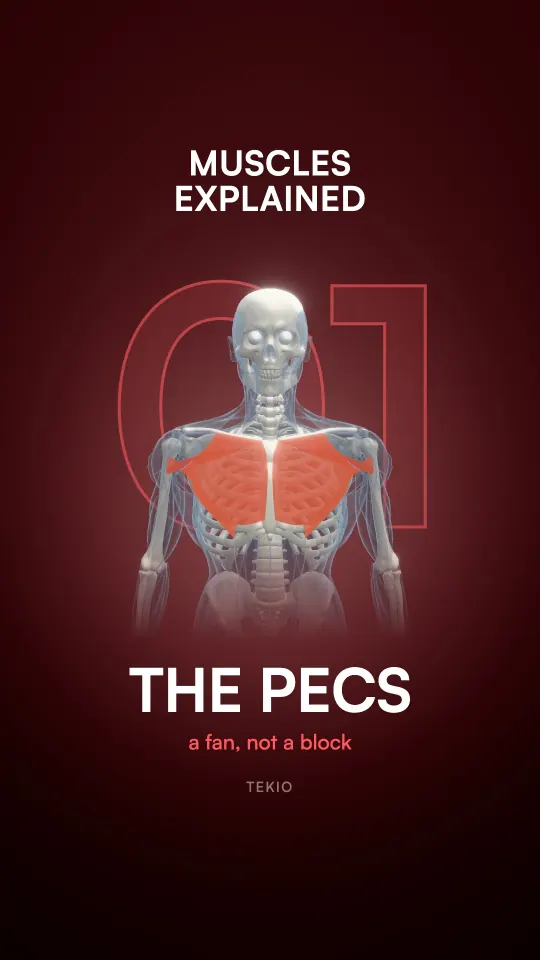
What are your pecs made of?
Your pecs are mostly the pectoralis major: a fan that starts at your collarbone, your breastbone and your ribs. It isn’t one solid block: in the dissection of 11 bodies, it had a clavicular part up top and a sternal part split into 6 to 7 segments, so 7 to 8 segments in all (Fung et al., 2009).
All of its fibers meet on your upper arm: in 14 donor arms, both parts ended on a single footprint on the humerus, about 7.5 cm long, through a single attachment (Huang et al., 2020). Its job: closing your arms in front of you, like a chest fly.
What does each part of the pectoralis major do?
Each part pulls your arm along the line of its fibers: the top lifts it forward, the bottom pulls it back down. Measured in 8 donor arms, the lever arms of the top part serve to raise your arm in front of you, those of the bottom part to pull it back down (Ackland et al., 2008).
In 8 men, during static efforts, the top segments fired to raise the arm, the bottom ones to bring it back down from the front, and the middle ones to close the arms in front of the body (Paton and Brown, 1994).
Which incline bench angle works the upper chest?
Incline the bench, and your arms press more toward your head: that’s the top’s move. In 30 trained lifters doing a free-weight bench press at 60% of their max, on 5 bench angles from 0 to 60°, the top of the pectoralis major fired most at 30°, but barely more than flat; the middle and bottom fired clearly more on the flat bench than at any incline (Rodríguez-Ridao et al., 2020).
Past 45°, the front of the shoulder was the most active, and the work of the pectoralis major dropped (Rodríguez-Ridao et al., 2020): a bench set too high mostly works your front delts. That’s measured muscle activity, not growth.
Does incline bench grow the upper chest more?
What lights up doesn’t tell you everything that grows. In beginner young men training once a week for 8 weeks on a Smith machine, the incline press at 44° thickened the upper chest about 6 mm more than the flat press. In the middle and bottom, no clear difference from flat (Chaves et al., 2020).
The group doing both exercises, with half the sets of each, grew the upper chest less than the incline group (Chaves et al., 2020). These were beginners: in trained lifters, the result may differ.
Should you keep the flat bench press?
Flat bench still has its place: in 15 men at 70% of their max, the sternal part of the pectoralis major, the middle and bottom, fired the most on the flat bench (Trebs et al., 2010). And in 13 men, right after the session, the flat bench swelled that sternal part more than the top part, while the 45° incline did the opposite (Albarello et al., 2022).
Your workout plan, built for your body.
In Tekio, your plan targets your pecs and you watch them progress on your body, week after week.

Sources
Studies checked in PubMed. Measured muscle activity isn’t growth: each fact keeps its study’s population and limits.
- Fung L, Wong B, Ravichandiran K, et al. (2009). Three-dimensional study of pectoralis major muscle and tendon architecture. Clin Anat 22(4):500-8. PubMed · DOI
- Huang BK, Wong JH, Haghighi P, et al. (2020). Pectoralis major tendon and enthesis: anatomic, magnetic resonance imaging, ultrasonographic, and histologic investigation. J Shoulder Elbow Surg 29(8):1590-1598. PubMed · DOI
- Ackland DC, Pak P, Richardson M, et al. (2008). Moment arms of the muscles crossing the anatomical shoulder. J Anat 213(4):383-90. PubMed · DOI
- Paton ME, Brown JM (1994). An electromyographic analysis of functional differentiation in human pectoralis major muscle. J Electromyogr Kinesiol 4(3):161-9. PubMed · DOI
- Rodríguez-Ridao D, Antequera-Vique JA, Martín-Fuentes I, et al. (2020). Effect of Five Bench Inclinations on the Electromyographic Activity of the Pectoralis Major, Anterior Deltoid, and Triceps Brachii during the Bench Press Exercise. Int J Environ Res Public Health 17(19):7339. PubMed · DOI
- Chaves SFN, Rocha-Júnior VA, Encarnação IGA, et al. (2020). Effects of Horizontal and Incline Bench Press on Neuromuscular Adaptations in Untrained Young Men. Int J Exerc Sci 13(6):859-872. PubMed · DOI
- Trebs AA, Brandenburg JP, Pitney WA (2010). An electromyography analysis of 3 muscles surrounding the shoulder joint during the performance of a chest press exercise at several angles. J Strength Cond Res 24(7):1925-30. PubMed · DOI
- Albarello JCDS, Cabral HV, Leitão BFM, et al. (2022). Non-uniform excitation of pectoralis major induced by changes in bench press inclination leads to uneven variations in the cross-sectional area measured by panoramic ultrasonography. J Electromyogr Kinesiol 67:102722. PubMed · DOI
These lessons inform; they don’t replace advice from a health professional.