The right exercise · Lesson 1
Kickback or hip abduction: which is best for glute growth?
The kickback, if you keep only one: in 17 young adults, 10 weeks of cable kickbacks grew the gluteus maximus by 9%, versus 5% for abductions done with the other leg. But each one mostly grew its own part: the bottom by 14% with kickbacks versus 1% with abductions, the top by 10% with abductions versus 5% with kickbacks. Keep the kickback, and add abductions for the top of your glutes.
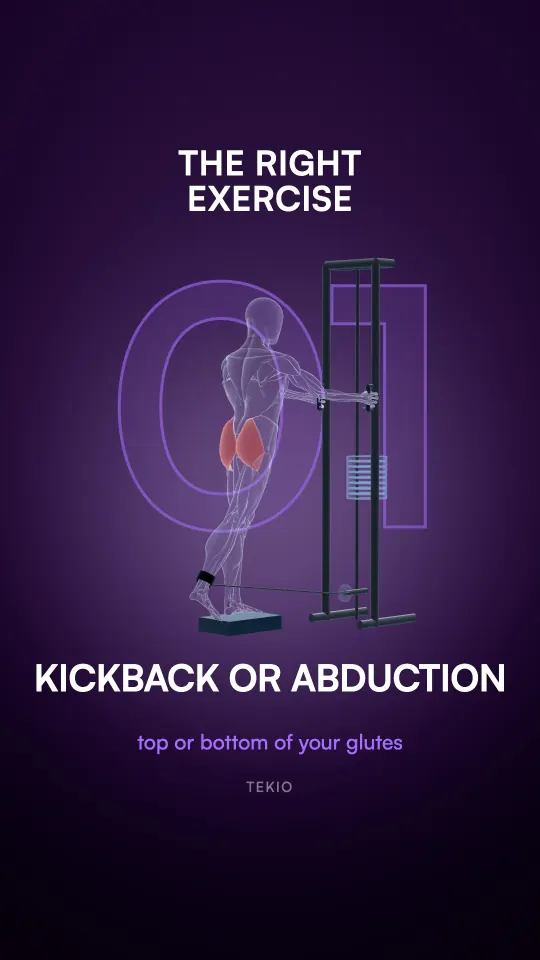
What do kickbacks and abductions do to your gluteus maximus?
Your gluteus maximus starts on your pelvis and attaches to your femur, your thigh bone. Its top and bottom don’t end in the same place: in 25 dissected bodies, its upper three quarters ended in a flat tendon fixed mostly to the femur, and its lower quarter on that tendon and on nearby tissue along the side of the thigh (Anetai et al., 2025). As it shortens, it pulls your thigh back: that’s hip extension, the kickback movement.
When your leg moves out to the side, that’s hip abduction, and this time it’s mostly the top that works. In 20 healthy people, fine-wire electrodes inserted into the top and bottom of the muscle recorded its activity across 11 common rehab exercises: the top was more active than the bottom in the 5 where the leg moved out or turned outward; in the other 6, there was no clear difference, and exercises built mainly on hip extension worked both parts about equally (Selkowitz et al., 2016). That’s electrical activity, not growth.
Kickback or abduction: which part grows more?
One study compared them in the same people. Seventeen young adults, 28 years old on average, trained one leg with cable kickbacks and the other with cable abductions, each leg randomly assigned, for 10 weeks: two sessions a week, about 10 sets a week, with a load they could lift 8 to 12 times at most. MRI measured the size of the gluteus maximus at the top, in the middle and at the bottom (Attarieh et al., 2026).
Both exercises grew it, the kickback more: +9% across the whole muscle, versus +5% with abductions. But not in the same places. With kickbacks, growth increased toward the bottom: +5% at the top, +8% in the middle, +14% at the bottom. With abductions, it was the reverse: +10% at the top, +4% in the middle and +1% at the bottom, next to nothing.
So abductions aren’t just for the gluteus medius, on the side of your hip: with them, the gluteus maximus grew as much as the medius and minimus combined (+5% versus +4%). With kickbacks, those two barely moved: +2%, with no clear increase (Attarieh et al., 2026). It’s one study, of 17 people: it needs confirming.
Why don’t the top and bottom grow the same?
Many people think one exercise grows the whole muscle evenly. Here, each part followed its own movement: the top, the part most active when the leg moves out, grew twice as much with abductions as with kickbacks. For the bottom, the electrodes don’t tell the whole story: in hip extension, the top and bottom were about equally active (Selkowitz et al., 2016), yet it’s the bottom that grew most with kickbacks.
The broader idea: a muscle grows mostly where it worked hardest. That’s what a triceps study observed: in 12 young men who trained their triceps for 12 weeks, the areas of the muscle most active in the first session, seen on MRI, were also the ones that grew most; for the authors, the muscle’s uneven growth comes from that area-by-area activity (Wakahara et al., 2013).
Should you do kickbacks, abductions or both?
If you keep only one, pick the kickback: it grew the gluteus maximus the most, especially its bottom. For the top of your glutes, add abductions. The study didn’t test the two together: that’s a deduction from its results, not a measurement.
Varying your exercises helps when each one brings something different. A review of 8 studies, all in young men, concludes that well-planned variation, chosen from the muscle’s anatomy and mechanics, seems to boost growth in some of its regions; switching exercises too often, or stacking ones that do the same job, may instead hold your progress back (Kassiano et al., 2022).
Your workout plan, built for your body.
In Tekio, your plan targets your glutes and you watch them progress on your body, week after week.

Sources
Studies checked in PubMed. Measured muscle activity isn’t growth: each fact keeps its study’s population and limits.
- Anetai H, Kato K, Kudoh H, et al. (2025). Structural re-evaluation of the human gluteus maximus. Sci Rep 15(1):21251. PubMed · DOI
- Selkowitz DM, Beneck GJ, Powers CM (2016). Comparison of Electromyographic Activity of the Superior and Inferior Portions of the Gluteus Maximus Muscle During Common Therapeutic Exercises. J Orthop Sports Phys Ther 46(9):794-9. PubMed · DOI
- Attarieh P, Nunes JP, Khani S, et al. (2026). Regional Hypertrophy of the Gluteal Muscles Is Task-Specific: Differential Responses to 10 Weeks of Hip Extension Versus Hip Abduction Training. J Strength Cond Res Epub 2026 Oct 7. PubMed · DOI
- Wakahara T, Fukutani A, Kawakami Y, et al. (2013). Nonuniform muscle hypertrophy: its relation to muscle activation in training session. Med Sci Sports Exerc 45(11):2158-65. PubMed · DOI
- Kassiano W, Nunes JP, Costa B, et al. (2022). Does Varying Resistance Exercises Promote Superior Muscle Hypertrophy and Strength Gains? A Systematic Review. J Strength Cond Res 36(6):1753-1762. PubMed · DOI
These lessons inform; they don’t replace advice from a health professional.